Far Northwest: Azcapotzalco on Foot
Why Azcapotzalco
Azcapotzalco was a capital before Tenochtitlan was. For a century the Tepanecs ran most of the Valley of Mexico from here, and the Mexicas paid them tribute. Today it is a borough of factories and housing estates in the north-west of the city, with a small old town center that most people in Mexico City have never visited.
The old center sits about 8 km north-west of the Zócalo, between Avenida Azcapotzalco and the Avenida 22 de Febrero. Around it are the barrios, old Indigenous villages that each kept a chapel and a patron saint. The walk covers the center, then heads north-east through three barrios to the ahuehuete of Santa Catarina.
This walk suits repeat visitors who want a neighborhood with no tourists at all, and anyone who likes cantinas, markets and parish churches. It is not polished. The barrio streets are ordinary, the main avenues are loud, the chapels are often locked and some plazas look tired. The center itself is lively and cheap.
Practical basics
The walk is about 2.7 km, one way, and takes half a day with stops. Take an Uber or taxi to the start and home from the end. Do it on a Sunday, when the cathedral is open all day and the main square is full.
| Start | Catedral de Azcapotzalco, Av. Morelos 14 |
| Finish | Capilla de Santa Catarina, Calle Central at Tlatenco, Barrio de Santa Catarina |
| Distance | About 2.7 km; roughly 35 minutes of pure walking |
| Time needed | 3–4 hours with the museums, a drink and lunch |
| Best day | Sunday: the cathedral is open all day and the square is at its busiest |
| Avoid | Saturday afternoons and weekday lunchtimes, when the cathedral is closed |
| Toilets | Buy something: Fragante Café, the cantinas and La Perla Tapatía all have them |
For public transport, Metro Camarones (Line 7) is under ten minutes’ walk south-west of the start. At the end, Metro Ferrería/Arena Ciudad de México (Line 6) is four minutes east of the Santa Catarina chapel.
Start at 10:00, when the cathedral opens. The cantinas open at 11:00, so there is time for a drink before lunch. Nobody will judge you. If you are short of time, end at the Plaza Cívica (stop 7) and skip the three barrios. That cuts about 1.6 km.
The center feels safe in daylight. Locals flag the south side of the Plaza Cívica at night, and one visitor was robbed in the Callejón del Beso, a narrow passage south of the center, so the route leaves it out. Cross Eje 4 Norte at the lights by Metro Ferrería, and keep your phone in a front pocket in the market.
A short history
The name is Nahuatl, usually translated as “in the place of the anthills”, and people from here still call themselves chintololos, after the same anthill. The ant turns up on the church tower and in the square. Between 1283 and 1343 the Tepanec ruler Acolhuatzin moved his capital to what is now the historic center. Under Tezozómoc, who ruled from 1367 to 1427, the Tepanecs controlled most of the Valley of Mexico. In 1428 the Triple Alliance of Tenochtitlan, Texcoco and Tlacopan defeated them and destroyed the city.
When the Spanish arrived the town had about 17,000 people. Dominican friars arrived in 1528–1529 and built their church in the 1560s, partly with the stones of a Tepanec ceremonial site. By 1709 there were 27 communities around it; many survive as barrios, each with its chapel.
On 19 August 1821 the Army of the Three Guarantees, under Anastasio Bustamante and Luis Quintanar, beat the royalists in the church atrium. It is usually called the last battle of the War of Independence. An insurgent known as El Pachón died moving a cannon; in 1910 his name, Encarnación Ortiz, was added to the Monumento a la Independencia on Reforma.
The Porfiriato brought a new town hall in 1891 and chalets for the middle class along the Avenida Azcapotzalco; a trolley to the city center followed in 1913. Then came industry. The first factories opened in Vallejo in 1929, the 18 de Marzo refinery was founded in the late 1930s, and José José, who grew up on these streets, sang his way out of them. Pedro Ramírez Vázquez delivered the new market in 1957, and in 1986 INAH declared the center a historic monument zone.
In 2011 the city named the historic center a Barrio Mágico. In 2019 the Pope created the Diocese of Azcapotzalco and the parish church became a cathedral. In 2020 INAH archaeologists found the stone base of a Tepanec house under the pedestrian walk in front of the market, and in June 2025 the city declared the 700-year-old ahuehuete of Santa Catarina a heritage tree.
The route
The walk runs one way, from the cathedral through the old center and the market, then north-east through the barrios of Los Reyes and San Marcos to Santa Catarina, in 10 numbered stops. Follow it on the Azcapotzalco on Foot map, which shows every stop, the walking route and the nearest coffee and bakeries.
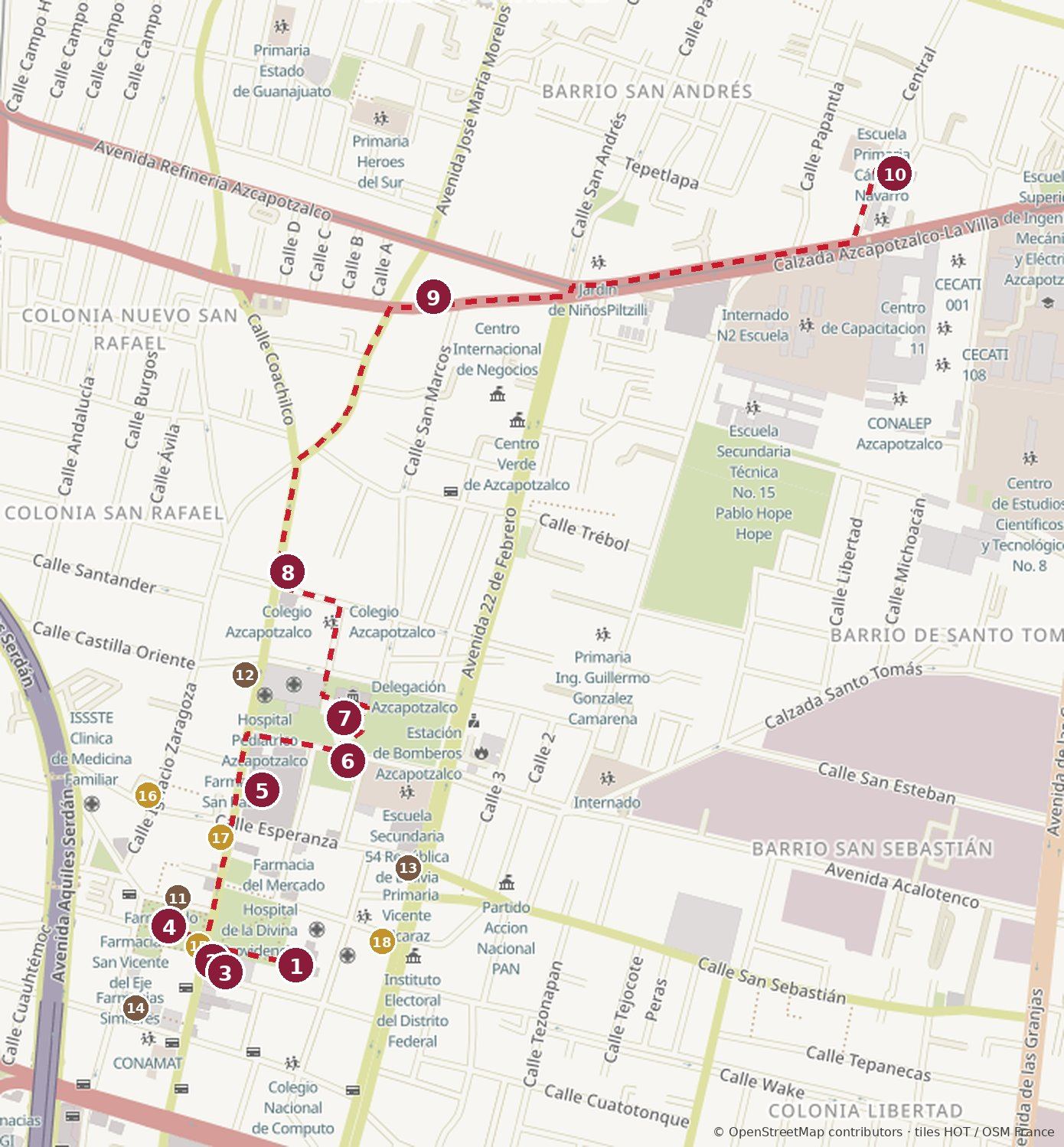
Coffee 11Fragante Café · 12Cafe Eleven 28 · 13Café La Te Te Ra · 14Cafetería Eskaparate
Bakeries 15Expendio Azcapo A&M · 16Panadería Marietta · 17Lecaroz Panadería · 18Panadería El Valle de Liébana
Click to enlarge. Map data © OpenStreetMap contributors.
| # | Stop | What it is |
|---|---|---|
| 1 | Catedral de Azcapotzalco | 16th-century Dominican church |
| 2 | Casa de Cultura de Azcapotzalco | The 1891 town hall |
| 3 | Biblioteca Fray Bartolomé de las Casas | Library with O’Gorman’s first mural |
| 4 | Jardín Hidalgo | The main square |
| 5 | Mercado de Azcapotzalco | 1957 market by Ramírez Vázquez |
| 6 | Paseo de las Hormigas | Pedestrian walk on a Tepanec site |
| 7 | Plaza Cívica Fernando Montes de Oca | Tezozómoc and the founders |
| 8 | Capilla de los Santos Reyes | Barrio chapel |
| 9 | Parroquia de San Marcos | Barrio church on the old road to La Villa |
| 10 | Capilla de Santa Catarina and the Viejo del Agua | 17th-century chapel and a 700-year-old ahuehuete |
The walk, part 1: the old center
The first half stays within a few blocks: the church, the town hall and library, and the square, with ice cream and the first cantina just off the route.
Before you start: Panadería El Valle de Liébana (Tepanecos 45; Mon–Fri 6:00–22:00, Sat–Sun 7:00–21:30), two minutes behind the cathedral, is a proper neighborhood panadería, all trays and tongs (gold circle on the map). The bread is fresh and cheap and the shop is not much to look at. In January they fill the rosca de reyes to order. Buy a concha for the walk.
1. Catedral de Azcapotzalco

Av. Morelos 14 · Mon–Fri 10:00–13:00 and 17:00–19:00, Sat 10:00–13:00, Sun 7:30–21:00 · free
Start at the front of the church, begun in 1565, badly damaged in the 1653 earthquake and reopened in 1702. Look for the ant on the tower: when it reaches the belfry, the story goes, the world ends. Inside, the Capilla del Rosario on the left has an elaborate altarpiece. The old cloister keeps fragments of a tequitqui mural, the Indigenous take on European painting, and rare coffered ceilings. The atrium, which Time Out once called the largest in the city, is where the battle of 1821 was fought. A statue of El Pachón stands nearby.
2. Casa de Cultura de Azcapotzalco

Av. Azcapotzalco 605 · daily 10:00–18:00; check hours · free
Two minutes away is the neoclassical town hall of 1891, which became the Casa de Cultura in 1991, its hundredth year. In the first courtyard are a fountain, a bust of the anthropologist Manuel Gamio and a sculpture of Matlacóatl and Azcueitl, the town’s legendary founders. A big mural on the staircase tells the local story from the Tepanecs on. The guards will tell you about the ghost of a bride who walks the building.
3. Biblioteca Fray Bartolomé de las Casas

Morelos y Pavón, beside the Casa de Cultura · daily 8:00–20:00 · free
Around the corner is the borough’s first library, opened in 1925. It is worth the detour for one thing: Paisaje de Azcapotzalco, the mural Juan O’Gorman painted across its walls in 1926, when he was 21. This was years before his studio houses for Diego Rivera and his Biblioteca Central at UNAM. Sign in and leave your bag on a shelf.
Ice cream: El Nevado (Av. Azcapotzalco 591; Mon–Fri 9:00–20:00, Sat 9:30–20:00, Sun 9:00–20:00) is a minute south. Time Out recommended it in 2013. It is also a lonchería, with tortas and breakfast. The rooms are worn and service is slow; it is always busy anyway.
A drink: across the avenue is El Dux de Venecia (Av. Azcapotzalco 586A; Mon–Sat 11:00–22:00, Sun 11:00–19:00), the older of the two cantinas, close to a hundred years old. Draft beer comes in bolas, the botanas arrive as you drink, and the kitchen does caracoles, shrimp broth and chamorro. The jukebox plays José José. It is dark, a little grubby and loved by its regulars; one calls it the Mexican Cheers. Opinions online range from “staple” to “dungeon”. I would go.
4. Jardín Hidalgo

16 de Septiembre, in front of the cathedral · open 24 hours · free
Walk about two minutes north-west to the square, or three from the Dux. The garden fills what was once the much larger church atrium, and it is the town’s living room, ringed by restaurants and cantinas and busiest on Sunday. Look for the ant statue and the foundation monument, both nods to the name. There is a playground, the Parque Siglo XXI, in the north-west corner of the old atrium.
Coffee break: Fragante Café (Jardín Miguel Hidalgo 11; Mon–Sat 9:00–21:00, Sun 9:00–20:00), on the square (brown circle on the map). Small and cheap, and service can be slow. Regulars recommend a drink called the Hijo del Maíz.
Or a beer: Cantina La Luna (Av. Azcapotzalco 634; daily 11:30–22:30), next door on the edge of the square, is the other old cantina, also close to a hundred years old by Time Out’s count. Draft beer, micheladas and snacks, at a table with a view of the church. Reviewers say the cocktails are weak and the beer is cheap. Order beer, then sober up at Fragante.
The walk, part 2: the market and the barrios
The second half crosses the market for lunch and walks over the buried Tepanec house to the borough’s civic plaza, then heads north-east through the barrios to the old ahuehuete.
5. Mercado de Azcapotzalco

Av. Azcapotzalco, between Esperanza and Jerusalén · daily 7:30–18:00 · free
Walk about five minutes north. The first market, the Mercado Siglo XX, opened a block away in 1901; this one, by Pedro Ramírez Vázquez, the architect of the Basílica de Guadalupe, replaced it in 1957. It has more than 500 stalls of produce, clothes, crafts and food.
Lunch: Los Jarochos, inside the market (Av. Azcapotzalco 665–687; daily 8:15–18:00), for seafood cocktails, ceviche and shrimp; one reviewer liked that you can buy socks at the same time. Try a diablito, shaved ice with chile, lime and tamarind. The alternative is La Perla Tapatía (Av. Azcapotzalco 706-B; Mon–Fri 8:00–18:30, Sat–Sun 8:00–17:00), a minute up the avenue: Jalisco-style birria, tacos, pozole and quesadillas, and jericallas for dessert. It is popular. If you ate at the market, have a taco anyway.
Coffee after lunch: Cafe Eleven 28 (Av. Azcapotzalco 722-D), a little further up the avenue past La Perla, does coffee, breakfast and pastries (brown circle on the map).
6. Paseo de las Hormigas
Jerusalén, in front of the market · open · free
Walk about three minutes east to the pedestrian walk named for the ants. In early 2020, after street vendors were moved off it, INAH archaeologists found the stone base of a house 1.2 to 2 meters down: a platform about 8 by 6 meters, from the late Postclassic, 1350–1519, part of the Tepanec city. They covered it again to protect it, so there is nothing to see. Stand on it anyway.
7. Plaza Cívica Fernando Montes de Oca

Jerusalén 5A, at 22 de Febrero · open 24 hours · free
Next to it is the borough’s civic plaza, part of the Parque Azcapotzalco. A large statue of Tezozómoc stands with the Tepanec founders, and another honors Fernando Montes de Oca, one of the Niños Héroes who died defending Chapultepec Castle in 1847. On Saturdays there are scouts, and dancers to pre-Hispanic drums. The south side has a bad reputation at night.
8. Capilla de los Santos Reyes

Capilla de los Reyes 6, Barrio de Los Reyes · check hours · free
Walk about five minutes north into the first barrio. The chapel of the Three Kings is a simple chapel with a bell tower, and it is usually quiet. If it is locked, look at the façade and walk on. The barrio’s fiesta is on 6 January, the day of the Kings.
9. Parroquia de San Marcos

Antigua Calzada de Guadalupe 24, Barrio de San Marcos · open mostly at Mass times; check hours · free
Walk about seven minutes north-east. The church stands on the Antigua Calzada de Guadalupe, the old road from Azcapotzalco to La Villa, now Eje 4 Norte. It is small and pretty, with flowers outside on feast days. San Marcos celebrates its saint on 25 April with a fair and fireworks, which the neighbors complain about every year.
10. Capilla de Santa Catarina and the Viejo del Agua
Calle Central at Tlatenco, Barrio de Santa Catarina · tree always visible; check chapel hours · free
Walk about ten minutes east, the longest stretch, to the end. The Capilla de Santa Catarina Mártir dates from the 17th century. Outside it stands an ahuehuete, a Montezuma cypress, about 700 years old by the city’s count and 730 by Chilango’s, which would make it older than Tenochtitlan. It is 27 meters tall with a trunk nearly 5 meters across. Local tradition says the Tepanecs planted it; neighbors water it once a week. In June 2025 the city declared it a heritage tree and named it the Viejo del Agua, “old man of the water”, which is what ahuehuete means. Next door is the Escuela Sotero Prieto, a primary school that Chilango credits to Juan O’Gorman, so the walk ends with him as well. The Santa Catarina fiesta is on 25 November. Metro Ferrería is four minutes east, or call an Uber from the corner.
Coffee, food and drink
For coffee, go to Fragante or Cafe Eleven 28; for lunch, Los Jarochos in the market or La Perla Tapatía; for a drink, El Dux de Venecia or La Luna.
| Place | What | Where |
|---|---|---|
| Fragante Café | Coffee, snacks, on the square | Jardín Miguel Hidalgo 11, stop 4 |
| Cafe Eleven 28 | Coffee, breakfast, pastries | Av. Azcapotzalco 722-D, near stop 5 |
| Café La Te Te Ra | Coffee and cakes; closed Sun | Av. 22 de Febrero 278, east of stop 1 |
| Cafetería Eskaparate | Espresso, hot chocolate; closed Sun | Aztecas 21, near stop 3 |
| Panadería El Valle de Liébana | Traditional bakery | Tepanecos 45, behind stop 1 |
| La Chica Pay | Cakes, pies, cookies, coffee | Av. Centenario 513, south of stop 3 |
| El Nevado | Ice cream, tortas | Av. Azcapotzalco 591, near stop 3 |
| Los Jarochos | Seafood cocktails, ceviche | Inside the market, stop 5 |
| La Perla Tapatía | Birria, pozole | Av. Azcapotzalco 706-B, near stop 5 |
| El Dux de Venecia | Cantina, botanas | Av. Azcapotzalco 586A, near stop 3 |
| Cantina La Luna | Cantina, draft beer | Av. Azcapotzalco 634, on the square, stop 4 |
If you just want a familiar cup, the chains sit at the south edge of the center:
- Starbucks in the Destino Azcapotzalco mall, Av. Centenario 520, a few minutes south-west of stop 3
- Starbucks at Calzada Camarones 510, Col. del Recreo, a short ride south
Shops worth the detour
Azcapotzalco has no shopping street. The market is the shopping.
- Mercado de Azcapotzalco (stop 5): produce, crafts, clothes, shoes and cooking pots.
- Panadería El Valle de Liébana (Tepanecos 45, behind stop 1): pan dulce for the ride home, and the rosca in January.
- Plaza Cívica (stop 7): locals say it often hosts fairs selling products from other states.
- Biblioteca Fray Bartolomé de las Casas (stop 3): a book exchange shelf.
- La Chica Pay (Av. Centenario 513): a carrot or banana cake to take home.
Which day to walk
Sunday gets you the most; Saturday afternoon the least. Only the stops with limited days are listed below.
| Stop | Mon | Tue–Fri | Sat | Sun |
|---|---|---|---|---|
| 1 Catedral | 10:00–13:00, 17:00–19:00 | 10:00–13:00, 17:00–19:00 | 10:00–13:00 | 7:30–21:00 |
| 2 Casa de Cultura | Check | Open | Open | Open |
| 9 San Marcos | Mass times | Mass times | Mass times | Mass times |
On a Saturday, get to the cathedral before 13:00, or start at the market and do the center last on a Sunday. On weekends La Perla Tapatía closes at 17:00, and on Sundays the Dux closes at 19:00.
Keep walking
Azcapotzalco connects to two other walks and one famous tree.
South: Clavería and Popotla. The Parque de la China in Clavería, about 20 minutes south, has a statue of José José that neighbors put up in 2012; they gathered there to say goodbye to him in September 2019. Further south, by Metro Popotla (Line 2) on the Calzada México-Tacuba, is the Árbol de la Noche Triste, the ahuehuete under which Hernán Cortés is said to have wept in 1520, renamed the Árbol de la Noche Victoriosa in 2021. Only the burned trunk is left. It is in Miguel Hidalgo, not Azcapotzalco.
North-west: Parque Tezozómoc. A 17-hectare park laid out in the 1980s as a model of the Valley of Mexico, with a lake and an islet for Tenochtitlan (closed Mondays). The Museo de Azcapotzalco, next to it, has the borough’s archaeology and is free. Take Metro Line 6 from Azcapotzalco station two stops to El Rosario, or a taxi.
East: La Villa. Metro Line 6 runs from Ferrería, by the last stop, straight to La Villa-Basílica. La Villa on Foot starts on the Calzada de los Misterios.
About the author and where to stay
Brian has lived in Roma Norte for about five years and writes the See Mexico City guides. He speaks seven languages and still gets lost on purpose.
When you visit, stay with us at Penthouse El Cielo de Roma in Roma Norte.
Photo credits
Photos via Wikimedia Commons, used under the licenses shown. Numbers match the captions.
- FelipeSantiagoAzca03.JPG, Thelmadatter, CC BY-SA 3.0
- CasaCulturaAzcapotzalco.JPG, Thelmadatter, CC BY-SA 3.0
- Biblioteca Fray Bartolomé de las Casas.jpg, ProtoplasmaKid, CC BY-SA 3.0
- PlazaHidalgoAzca03.JPG, Thelmadatter, CC BY-SA 3.0
- Los Jarochos de Azcapotzalco.jpg, Wotancito, CC BY-SA 4.0
- Azcapotzalco – Escultura de Tezozomoc.JPG, ProtoplasmaKid, CC BY-SA 4.0
- Capilla de los Reyes (Azcapotzalco) 03.JPG, Dge, CC BY-SA 4.0
- Parroquia de San Marcos, San Marcos, Azcapotzalco (1).jpg, RicardoGGEE, CC BY-SA 4.0
Map: drawn from OpenStreetMap data, © OpenStreetMap contributors, Open Database License.
Sources
Hours and prices checked October 2026; confirm before you go.
- Wikipedia: Azcapotzalco
- Mexico City tourism: Jardín Hidalgo and the Cathedral atrium, San Felipe and Santiago Apóstoles, Azcapotzalco Market, Azcapotzalco Centro, Delicias chilangas: Azcapotzalco
- Time Out México: 6 razones para visitar Azcapotzalco (2013)
- Time Out México: Casa de Cultura de Azcapotzalco
- Time Out México: Guía gastronómica de Azcapotzalco (2020)
- Chilango: 10 lugares de Azcapotzalco que todo chilango debe conocer
- Chilango: Visita estos lugares poco conocidos de Azcapotzalco
- Chilango: Declararán a 12 ahuehuetes y fresnos árboles patrimoniales
- N+: ‘Viejo del Agua’, 700 años viendo la transformación de la Ciudad de México
- N+: ¿Dónde está el Árbol de la Noche Triste?
- N+: Lista completa de todos los Barrios Mágicos de la CDMX
- El Universal: Declaran árbol patrimonial al ahuehuete de Santa Catarina
- México Desconocido: Batalla de Azcapotzalco, la última lucha por la Independencia
- Mexico News Daily: Archaeologists find foundations of pre-Hispanic home in Azcapotzalco
- La Jornada: Rescatan museo de Azcapotzalco