Far South: Tlalpan Centro on Foot
Why Tlalpan Centro
Tlalpan Centro is a colonial town the city swallowed without quite digesting: a plaza with a kiosk, a 17th-century parish, a Porfirian market, a cantina pouring for about 150 years, country houses of presidents and film stars, and a chapel by Luis Barragán that most people in Mexico City have never heard of.
It sits at the far south of the city, where Insurgentes Sur and the Calzada de Tlalpan start climbing towards the Ajusco. The old town, officially San Agustín de las Cuevas, covers 54 blocks between Avenida San Fernando, Insurgentes, the Calzada and La Joya. The walls are high, and behind most of them is a garden.
This walk suits people who have done Roma, Condesa and Coyoacán and want the version without tour groups. It is a long ride from Roma (45 minutes to an hour in traffic), and the first leg, from the Bosque de Tlalpan to the centro, is a plain walk along busy roads. The old town itself is quiet and easy.
Practical basics
The walk is about 4.9 km, one way, and takes most of a day with stops. Take an Uber or taxi to the start and home from the end. Do it on a Saturday if you can.
| Start | Casa de la Cultura de Tlalpan, Camino a Santa Teresa, at the edge of the Bosque de Tlalpan |
| Finish | Hacienda de San Fernando, Av. San Fernando 106; the Antigua Hacienda de Tlalpan, for a late lunch, is about seven minutes away |
| Distance | About 4.9 km; roughly 1 hour 5 minutes of pure walking |
| Time needed | 4–5 hours with a museum, lunch and a drink |
| Best day | Saturday: the Casa del Virrey and the Museo del Tiempo are open, and so is La Jalisciense |
| Avoid | Mondays, when the Museo del Tiempo and the Casa del Virrey are closed; Sundays, when La Jalisciense is |
| Toilets | Buy something: Café Katsina, the Fondo de Cultura bookstore café and the Antigua Hacienda all have them |
Half the walking is the first leg, 2.5 km from the Casa de la Cultura to El Calvario. To skip it, take a taxi straight to El Calvario (stop 2); the walk drops to about 2.4 km. The Capuchinas chapel (stop 11) is by appointment only, so call ahead and build the walk around your slot.
If you come by public transport, Metrobús Line 1 stops at Villa Olímpica, about 15 minutes’ walk east of the Casa de la Cultura, and at Fuentes Brotantes, right next to El Calvario. From the Antigua Hacienda, the Tren Ligero station at Huipulco is about 20 minutes north along the Calzada de Tlalpan.
The old town feels safe in daylight and fills with families on weekends. Walk the first leg in daylight, keep your phone in a front pocket on Insurgentes, where Metrobús riders warn about pickpockets, and don’t go into the Fuentes Brotantes park alone at dawn or dusk.
A short history
Around the year 100 the Xitle volcano buried Cuicuilco, one of the oldest towns in the Valley of Mexico, under the lava that still forms the Pedregal. The lava left caves, and the caves named the colonial town. Franciscans arrived in the 1530s on August 28, the feast of Saint Augustine, and dedicated their church to him. In 1645 the village became the Villa de San Agustín de las Cuevas.
It was a town of orchards and springs, and the city’s rich built country houses and haciendas here behind long walls. In 1827 the town was made a city and named Tlalpan, and for a few years it was the capital of the State of Mexico. The state ran its own mint here from 1828 to 1830. It lost money and closed, and its coins (marked EoMo) are now scarce and expensive.
In August 1847 American troops on their way to Padierna and Churubusco took over the Casa Chata and the mint. During the French Intervention, opponents of the French were hanged from a tree in the plaza still called the Árbol de los Colgados. The Porfiriato brought the railroad in 1869, the country’s first long-distance telephone call in 1878, a market in 1900 and a town hall in 1902.
Zapatistas used the old houses as barracks during the Revolution, and in 1928 Tlalpan became one of the city’s boroughs. Then the houses got famous owners: Adolfo López Mateos in the Casa Frissac, María Félix at the Finca Catipoato, where she married Jorge Negrete on October 18, 1952. Luis Buñuel filmed Los olvidados (1950) on these corners.
In 2011 the city named the centro one of its first Barrios Mágicos. INAH lists 64 buildings here as historic monuments, and so many religious orders have houses in the area (50 of the 70 in the borough, according to La Jornada in 2024) that locals call it El Vaticanito.
The route
The walk runs one way, from the edge of the Bosque de Tlalpan east into the old town, around the plaza, past the convents to the Casa Chata and north to Avenida San Fernando, in 13 numbered stops. Follow it on the Tlalpan Centro on Foot map, which shows every stop, the walking route, coffee places and bakeries, and the nearest chain cafés.
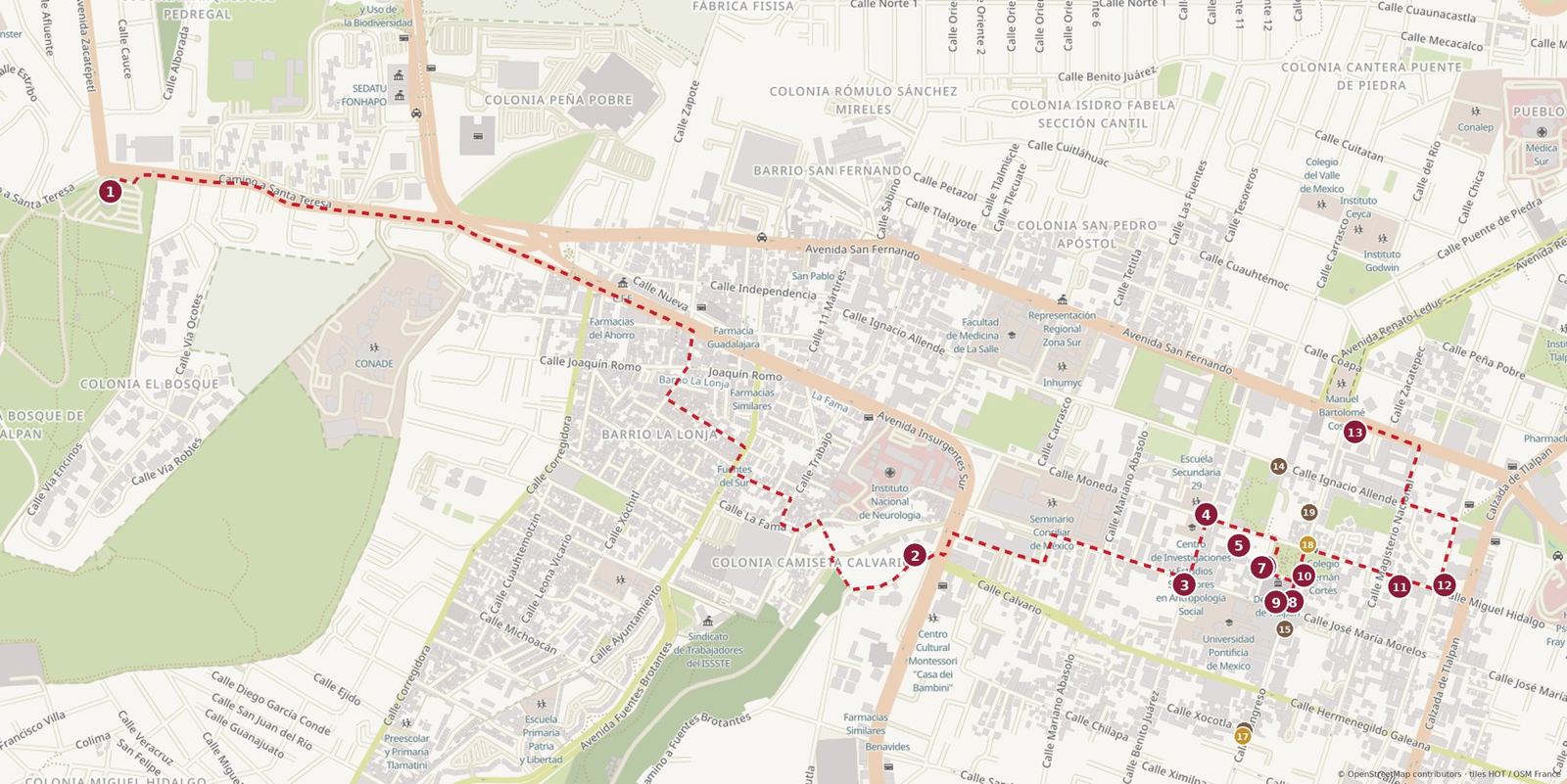
Coffee 14Librería FCE Elsa Cecilia Frost (café) · 15Congreso Café · 16Congreso Café La Tostadora · 19Café Katsina
Bakeries 17Fruto de Horno · 18A Punto de Nieve
Click to enlarge. Map data © OpenStreetMap contributors.
| # | Stop | What it is |
|---|---|---|
| 1 | Casa de la Cultura de Tlalpan | Pump-house facade on the Bosque |
| 2 | Capilla de El Calvario | Old barrio chapel |
| 3 | Casa del Virrey de Mendoza | Colonial house, cultural center |
| 4 | Antigua Casa de Moneda | State mint, 1828–1830 |
| 5 | Casa Frissac | Porfirian mansion, cultural center |
| 6 | Plaza de la Constitución and Antiguo Palacio | Main square, kiosk, town hall |
| 7 | Museo del Tiempo | Clock and phonograph museum |
| 8 | Museo de Historia de Tlalpan | La Casona, 1874 |
| 9 | Mercado de la Paz | Porfirian market, 1900 |
| 10 | Parroquia de San Agustín de las Cuevas | 17th-century parish church |
| 11 | Capilla de las Capuchinas | Luis Barragán’s chapel |
| 12 | Casa Chata | 18th-century country house |
| 13 | Hacienda de San Fernando | Old hacienda facade |
The walk, part 1: the Bosque to the plaza
The first half gets the long walk out of the way, then works through the old houses on the west side of the centro to the plaza.
1. Casa de la Cultura de Tlalpan
Camino a Santa Teresa s/n · Mon–Fri 8:00–20:00, Sat–Sun 8:00–19:00 · free
The facade looks like it belongs somewhere else, and it does. Engineer Alberto J. Pani designed it in 1907 for a water pumping station in the Condesa, on today’s Plaza de los Compositores. The pumps stopped in 1940; in 1975 the stone front was taken apart and moved here, and Pedro Ramírez Vázquez built a cultural center behind it, finished in 1988. Look for the turtles, snakes, snails and tritons in the chiluca stone. The Neptune from the central niche is lost.
Inside are a gallery and classrooms, and on Sundays a market of organic food, bread and crafts. The main gate of the Bosque de Tlalpan is a few minutes west.
From here it is about 2.5 km, a bit over half an hour, east to Insurgentes and south to El Calvario. It is not a pretty half hour.
2. Capilla de El Calvario
Av. Insurgentes Sur 3939 · check hours; most reliably open Sunday mornings · free
A small chapel by the Fuentes Brotantes Metrobús stop, almost all that is left of the old barrio of El Calvario. The city tourism office says there has been a chapel here since around 1531; it was rebuilt in 1774 to replace an adobe one, and most of what you see is 20th century. It is often locked; if it is open, go in.
Coffee break: there is no independent café on the first leg. The nearest cup is Cielito Querido in Patio Tlalpan (Insurgentes Sur 4177), about seven minutes south along Insurgentes. Otherwise hold out for the centro.
3. Casa del Virrey de Mendoza
Benito Juárez 15 · Tue–Sat 12:00–18:00 · free
Walk about ten minutes east into the centro. Tradition says Antonio de Mendoza, the first viceroy of New Spain, rested here. Neighbors fought to stop it becoming a real estate project, La Jornada reports, and it is now a community cultural center with a library donated by journalist Carlos Payán, free workshops and a garden to sit in.
4. Antigua Casa de Moneda
Calle Moneda 13 · exterior only · free
Two minutes on is the one for numismatists. A late 17th-century hospice, then a private house, it was sold to the State of Mexico after Independence and struck the state’s coins from 1828 to 1830. American troops used it in 1847, Juárez’s in 1858, the Zapatistas after them. Since the 1950s it has been Secundaria No. 29, so you cannot go in. Look up instead: the arches over Calle Moneda are inverted, holding the walls apart.
Coffee break: the Fondo de Cultura bookstore in the Parque Juana de Asbaje, on Allende just north of the plaza, has a small café. Brown circle on the map.
5. Casa Frissac
Calle Moneda at Plaza de la Constitución · daily 8:00–20:00 · free
A minute further along Moneda is a French-style mansion from the late 19th century, built for hacendado Jesús Pliego Frissac and left empty for decades after the Revolution. In the 1950s Adolfo López Mateos, president from 1958 to 1964, made it his family home; UNAM rector Javier Barros Sierra lived here too. Now it is a free cultural center with shows and a garden. The legend that the bandit Chucho el Roto courted a Frissac niece here has one problem: he died before the house was built. In front, the Plaza del Bolero honors Armando Manzanero.
6. Plaza de la Constitución and Antiguo Palacio

Plaza de la Constitución · open space; palace Mon–Fri 8:00–18:00 · free
The Antiguo Palacio Municipal, now the alcaldía. Photo: [1]
Walk two minutes into the plaza. The kiosk and garden date from 1872, and the Árbol de los Colgados is still among the trees. Older couples dance danzón here on weekends.
The Antiguo Palacio Municipal, built 1898–1902 in volcanic stone to a design by Antonio Rivas Mercado, architect of the Ángel de la Independencia, is still the borough’s headquarters. Walk in during office hours for Roberto Rodríguez Navarro’s mural 3 mil años de historia de Tlalpan.
7. Museo del Tiempo
Plaza de la Constitución 7 · Tue–Sun 10:00–19:00 (check) · 60 pesos (~3 USD) in 2019, check current price
On the plaza. About 1,500 working clocks, music boxes, gramophones, jukeboxes and radios, the oldest from 1705, in what was the telephone exchange until 1964. Markus Frehner opened it in 2009. Visits are guided and take about an hour and a half; he does not believe in labels or audioguides.
Drink stop: La Jalisciense (Plaza de la Constitución 6, Mon–Sat 13:00–1:00, closed Sun), next door, a cantina pouring since about 1870. Order a tequila on the rocks and a torta de bacalao.
The walk, part 2: the market to San Fernando
The second half covers the south and east sides of the plaza, then heads into the quiet streets of convents and country houses.
8. Museo de Historia de Tlalpan
Plaza de la Constitución 10 · Tue–Sun 10:00–18:00 (check) · free
Two minutes along the plaza. La Casona was built in 1874 on land the Reform Laws took from the parish. On March 20, 1878, Mexico’s first long-distance telephone call was made from here to the capital. Novelist Heriberto Frías lived here from 1910 to 1915. It has been a museum since 2003, with free temporary shows that change about every two months.
9. Mercado de la Paz
Guadalupe Victoria 97 at Congreso · daily 7:00–18:30 · free
Next door. Opened on November 20, 1900, with Porfirio Díaz cutting the ribbon. Chilango calls it the only market of its era that keeps its original structure: red brick, stone columns and the old black floor. The lion-head fountain went in the 1950s to make room for stalls.
Lunch: the market fondas. The local dish is caldo tlalpeño, and La Jornada passes on the story that a cook invented it, with vegetables, xoconostle and plenty of chile, for a hungover Santa Anna. There is barbacoa too. Or sit down at Quinta Soledad (Calle Moneda 15), for mole and sopa de tortilla in a Porfirian house.
10. Parroquia de San Agustín de las Cuevas
Francisco I. Madero 10 · check hours · free
A minute or two away, on Madero. The first church was begun in 1532; the present one went up between 1637 and 1647. The facade is plain, the atrium big and shady, and inside are three naves, side chapels and a cloister. The tower clock installed in 1830 stopped in 1932 and then disappeared. The fiesta is on August 28.
Coffee break: Café Katsina (Francisco I. Madero 15, Mon–Fri 8:30–17:00, check weekends), two minutes north up Madero, the best coffee on the walk. Or Congreso Café (Calle Congreso 6), by the market. A Punto de Nieve (Madero 16) is the bakery for guava and cheese rolls. Brown and gold circles on the map.
11. Capilla de las Capuchinas
Miguel Hidalgo 43 · by appointment only; call 55 5573 2395 · 200 pesos (~10.50 USD), cash
Walk about four minutes east. Luis Barragán offered his services to the Capuchin nuns in 1954 and paid for part of the work himself; the chapel was consecrated in 1960. The altar has no images, only gold panels, and Mathias Goeritz did the lattice and stained glass. The light is the whole thing. Ring the convent bell at your time and a nun will show you round for 30 to 40 minutes. No photos.
12. Casa Chata
Miguel Hidalgo at Matamoros · bookstore Mon–Fri 9:00–20:00 · free
A minute further east. An 18th-century country house that once filled a whole block, named for its cut-off (“chata”) corner doorway. The pink cantera portal came from the 16th-century Colegio de San Pablo. It has been an Anglican seminary, a Zapatista barracks and a charrería museum, and in 1940 Lázaro Cárdenas had the widened Calzada take its orchards rather than the house. Since 1972 it has belonged to CIESAS, the anthropology research center; its bookstore is the way in.
13. Hacienda de San Fernando
Av. San Fernando 106 · exterior only · free
Walk about seven minutes north up Matamoros. At the corner of Allende is the Finca Catipoato, María Félix’s house. Little of it survives, and it is private. Keep on to Avenida San Fernando. La Jornada places Santa Anna’s house at number 106, and a hacienda on this avenue that keeps its old facade and rents its gardens for parties. Today 106 is an event venue under the hacienda’s name, so unless you are invited to a wedding, you get the wall and the gate.
Late lunch: the Antigua Hacienda de Tlalpan (Calzada de Tlalpan 4619, Mon–Fri 8:00–1:00, Sat 9:00–1:00, Sun 9:00–19:00), about seven minutes south-east, for a long meal in an 1837 hacienda. Then call an Uber from the Calzada.
Coffee, food and drink
For coffee, go to Café Katsina or Congreso; for lunch, the Mercado de la Paz; for a drink, La Jalisciense; for a long late lunch or dinner, the Antigua Hacienda.
| Place | What | Where |
|---|---|---|
| Café Katsina | Specialty coffee, beans, bookshop | Francisco I. Madero 15, near stop 10 |
| Congreso Café | Specialty coffee, house pastries | Calle Congreso 6, by stop 9 |
| Congreso Café La Tostadora | Their roastery café | Calle Congreso 79, south of the market |
| Fruto de Horno | Coffee, artisan bread and pastries | Calle Congreso 79 |
| A Punto de Nieve | Bakery: guava and cheese rolls | Francisco I. Madero 16, near stop 10 |
| Librería Elsa Cecilia Frost café | Small café in the bookstore | Parque Juana de Asbaje, near stop 4 |
| Mercado de la Paz | Caldo tlalpeño, barbacoa | Stop 9 |
| La Jalisciense | Cantina, tortas de bacalao | Plaza de la Constitución 6, by stop 7 |
| Los Goliardos | Pizza and pasta under the arches | Plaza de la Constitución 17-G |
| Los Bigotes de Carranza | Craft beer, tortas de cochinita | Francisco I. Madero 16C |
| Quinta Soledad | Mole and sopa de tortilla in a Porfirian house | Calle Moneda 15, near stop 4 |
| Antigua Hacienda de Tlalpan | Mexican, chiles en nogada | Calzada de Tlalpan 4619, after stop 13 |
Café Katsina roasts its coffee in house, in rooms shared with the El Desastre bookshop. The chairs are not the point. Buy a bag of beans.
La Jalisciense’s owner, Miguel Fernández, dates it to 1870 and admits there are no papers, but an 1875 lithograph shows it on the plaza. He reopened it in 1973 after fixing a building full of bullet holes, and says nothing has changed since. The telenovela Destilando amor shot its bar scenes here. Tortas run 110–140 pesos (~6–7 USD).
The Antigua Hacienda de Tlalpan was built in 1837. General Manuel González bought it in 1876 and used it as a retreat while he was president (1880–1884), keeping the chair warm for Porfirio Díaz. In 1904 the Porfiristas met here to nominate Díaz for yet another term; the plaque is still there. It has been a restaurant since 1982, with stone arcades, gardens and peacocks between the tables. Order the sopa de tortilla, or chiles en nogada, served all year.
If you just want a familiar cup, the chains sit at the edges of the route:
- Café La Selva on Madero, by the plaza
- Starbucks and Cielito Querido in Patio Tlalpan, Insurgentes Sur 4177, near stop 2
- Starbucks at Calzada de Tlalpan 4998, a few minutes south of the Antigua Hacienda
- Starbucks at Calzada de Tlalpan 4253, north of the Antigua Hacienda
Shops worth the detour
Tlalpan’s shopping is books, food and whatever the nuns are selling.
- Librería Elsa Cecilia Frost (Fondo de Cultura Económica): a two-floor bookstore with a small café in the Parque Juana de Asbaje, on Allende just north of the plaza. Mon–Sat 10:00–19:00, Sun 10:00–16:00.
- CIESAS bookstore (stop 12): anthropology, history and linguistics from the research center, in the Casa Chata.
- Café Katsina (Madero 15, near stop 10): roasted beans, plus the El Desastre bookshop in the same rooms.
- Mercado de la Paz (stop 9): piñatas, flowers, medicinal herbs and crafts.
- Sunday market at the Casa de la Cultura (stop 1): organic produce, bread and crafts.
Which day to walk
Saturday gets you the most; Monday the least. Only the stops with limited days are listed below.
| Stop | Mon | Tue–Fri | Sat | Sun |
|---|---|---|---|---|
| 1 Casa de la Cultura | Open | Open | Open | Open + market |
| 2 El Calvario | Mornings, check | Mornings, check (not Wed) | Usually closed | Morning masses |
| 3 Casa del Virrey | Closed | 12:00–18:00 | 12:00–18:00 | Closed |
| 7 Museo del Tiempo | Closed | Open | Open | Open |
| 8 Museo de Historia | Check | Open | Open | Open |
| 11 Capuchinas | By appointment | By appointment | By appointment | By appointment |
| 12 Casa Chata bookstore | Open | Open | Check | Closed |
La Jalisciense opens at 13:00 and is closed on Sunday; check Café Katsina’s weekend hours. On a Sunday, start at the Casa de la Cultura market, catch El Calvario open, and have your drink at the Antigua Hacienda instead of La Jalisciense. It closes at 19:00.
Keep walking
Two green additions are close to the route.
West: the Bosque de Tlalpan and Cuicuilco. From stop 1, the main gate of the Bosque is a few minutes west on Camino a Santa Teresa: 304 hectares of pines, oaks and lava paths, open early morning to about 17:00 (check hours). The Cuicuilco archaeological zone, with its round pyramid from before the Xitle eruption, is off Insurgentes at Periférico, about 20 minutes north-east of stop 1.
Next to stop 2: Fuentes Brotantes. A small national park of springs, ponds, ducks and turtles, with food stalls at the bottom entrance. Go in daylight and with company.
South-east: Xochimilco. From the Antigua Hacienda, take the Tren Ligero from Huipulco south to the end of the line for the canals.
About the author and where to stay
Brian has lived in Roma Norte for about five years and writes the See Mexico City guides. He speaks seven languages and still gets lost on purpose.
When you visit, stay with us at Penthouse El Cielo de Roma in Roma Norte.
Photo credits
Photos via Wikimedia Commons, used under the licenses shown. Numbers match the captions.
- Palacio Municipal (Tlalpan) 2012-09-09 14-26-43.jpg, Rodrisar, CC BY-SA 3.0
Map: drawn from OpenStreetMap data, © OpenStreetMap contributors, Open Database License.
Sources
Hours and prices checked October 2026; confirm before you go.
- Wikipedia: Tlalpan
- Hispanopedia (mirror of Spanish Wikipedia): Tlalpan
- Spanish Wikipedia: Casa de Cultura de Tlalpan
- La Jornada: En realidad se llama San Agustín de las Cuevas (November 2024)
- Chilango: Ruta de templos, museos y casonas enigmáticas en Tlalpan
- Chilango: 10 lugares gratis en el centro de Tlalpan
- Chilango: Historia de Casa Frissac
- Chilango: Museo del Tiempo
- Chilango: Los mercados más antiguos de la CDMX
- Chilango: Reabren bosques de CDMX
- El Universal: La casa “Chata”, la más antigua de Tlalpan
- El Financiero: Así es La Jalisciense, cantina con 155 años
- Food & Pleasure: Antigua Hacienda de Tlalpan
- Excélsior: Restaurantes en Tlalpan Centro
- Time Out México: Camina por Tlalpan, Bosque de Tlalpan
- CDMX Secreta: Qué hacer en el centro de Tlalpan
- N+: Lista de todos los Barrios Mágicos de la CDMX
- Mexico City tourism: San Agustín de las Cuevas, Mercado La Paz, Museo de Historia de Tlalpan, Museo del Tiempo, Casa Chata, Antigua Casa de Moneda, Capilla de El Calvario, Capuchin Convent Chapel, Casa de la Cultura
- Barragan Foundation: Capuchin Convent Chapel
- Lonely Planet: Capilla de las Capuchinas Sacramentarias
- INAH: Casa de Cultura de Tlalpan
- Coin Varieties: Mexico 1829-EoMo LF 8 reales