Southeast: Culhuacán on Foot
Why Culhuacán
Culhuacán is older than Tenochtitlan, and it does not look it. Behind the Metro and the traffic of Avenida Tláhuac there is a 16th-century Augustinian convent with its murals still on the walls, the remains of what was probably the first paper mill in the Americas, a stone stairway down to a lake that is no longer there, and a stretch of the canal that once carried boats into the city.
It sits in Iztapalapa, at the western foot of the Cerro de la Estrella, where the Mexica lit the New Fire every 52 years. On the map it is a small grid of streets around the convent, with eleven barrios around it and the border with Coyoacán just to the west. From Roma it is about 40 minutes by car, longer at rush hour.
This walk suits people who like history more than polish. It is not pretty. Avenida Tláhuac is loud and ugly, the eating is carnitas and fondas rather than cafés, and you will see very few visitors. The convent alone is worth the trip, and the rest shows you a pueblo originario that still runs its own fiestas.
Practical basics
The walk is about 2.8 km, one way, and takes half a day with stops. Take an Uber or taxi to the start and home from the end. Do it on a Wednesday, Thursday or Friday.
| Start | Ex-convento de San Juan Evangelista, Morelos 10 |
| Finish | Parroquia de San Francisco de Asís, San Francisco 24, San Francisco Culhuacán |
| Distance | About 2.8 km; roughly 40 minutes of pure walking |
| Time needed | 3–4 hours with the museum, tacos and coffee |
| Best day | Wednesday to Friday: the convent, Café del Alma and the San Francisco church are all open |
| Avoid | Weekends and Mondays, when the convent is closed; Tuesday, when the San Francisco church is |
| Toilets | Inside the convent, and at Café del Alma and Cafetería Nacional if you buy something |
Start at 10:00, when the convent opens; Café del Alma does not open until 13:00, which fits the pace of the route. If you are short of time, do the first five stops around the convent and the market, about 630 m in all, and take a taxi from there.
If you come by public transport, Metro Culhuacán (Line 12) is on Avenida Tláhuac about five minutes’ walk south of the convent, and the walk passes right by it at stop 5. From the finish, call an Uber; the nearest Metro is Culhuacán again, about 15 minutes back east.
Be sensible here. Walk on a weekday in daylight, stay on the main streets and the ones named in this guide, and keep your phone and wallet out of sight on Avenida Tláhuac and in the Metro. Don’t wander into side streets off the route, and skip the Plazuela de Los Reyes, north of the convent, where neighbors complain of drinking and drug use. The canal path is fine when other people are using it; if it is empty, walk along the street instead. Finish by late afternoon and leave by car.
A short history
People were living here by about 300 BC, according to INAH, on the western slope of the Cerro de la Estrella and the northern shore of the lake of Chalco and Xochimilco. The city-state of Culhuacán grew up around the year 600 and took its prestige from its links with Teotihuacan and then the Toltecs. Its glyph, a curved hill, is still painted in the convent cells.
The Mexica who arrived later in the valley wanted that lineage. They married into the Culhua nobility, and Culhuacán gave Tenochtitlan its first ruler. On top of the Cerro de la Estrella the Mexica held the New Fire ceremony, which renewed the world at the end of each 52-year cycle. The last one was in 1507, twelve years before Cortés.
After the conquest the Augustinians took over. INAH dates the convent of San Juan Evangelista to 1552–1554 (other sources say 1560). It was a school for friars learning Nahuatl and Otomí, and a map drawn in 1580 shows the sacred hill, the roads, the canals and the chapels. The convent had its own entrance by water, from a channel off the Canal Nacional. The friars needed paper, and water was plentiful, so they built a paper mill.
In 1756 the Crown took the convent away from the Augustinians. It became a parish house, then the seat of the local mayordomía, a Zapatista barracks during the Revolution and a tenement. The roof of the old church fell in at the end of the 19th century, and the present parish church next door was built with its stones.
INAH declared the building a monument and began restoring it in 1944. It reopened as a community center in 1983, and in 1992 the Parque Histórico behind it, designed by Mario Schejtnan with the neighbors, won the gold medal at the Bienal de Arquitectura Mexicana. Culhuacán is now one of the city’s Barrios Mágicos. Its eleven barrios still carry a 16th-century cane-paste Christ, the Santo Entierro, from one fiesta to the next.
The route
The walk runs one way, from the convent south along Avenida Tláhuac to the Canal Nacional, then west across into San Francisco Culhuacán, in Coyoacán, in 8 numbered stops. Follow it on the Culhuacán on Foot map, which shows every stop, the walking route and the nearest coffee and bakeries.
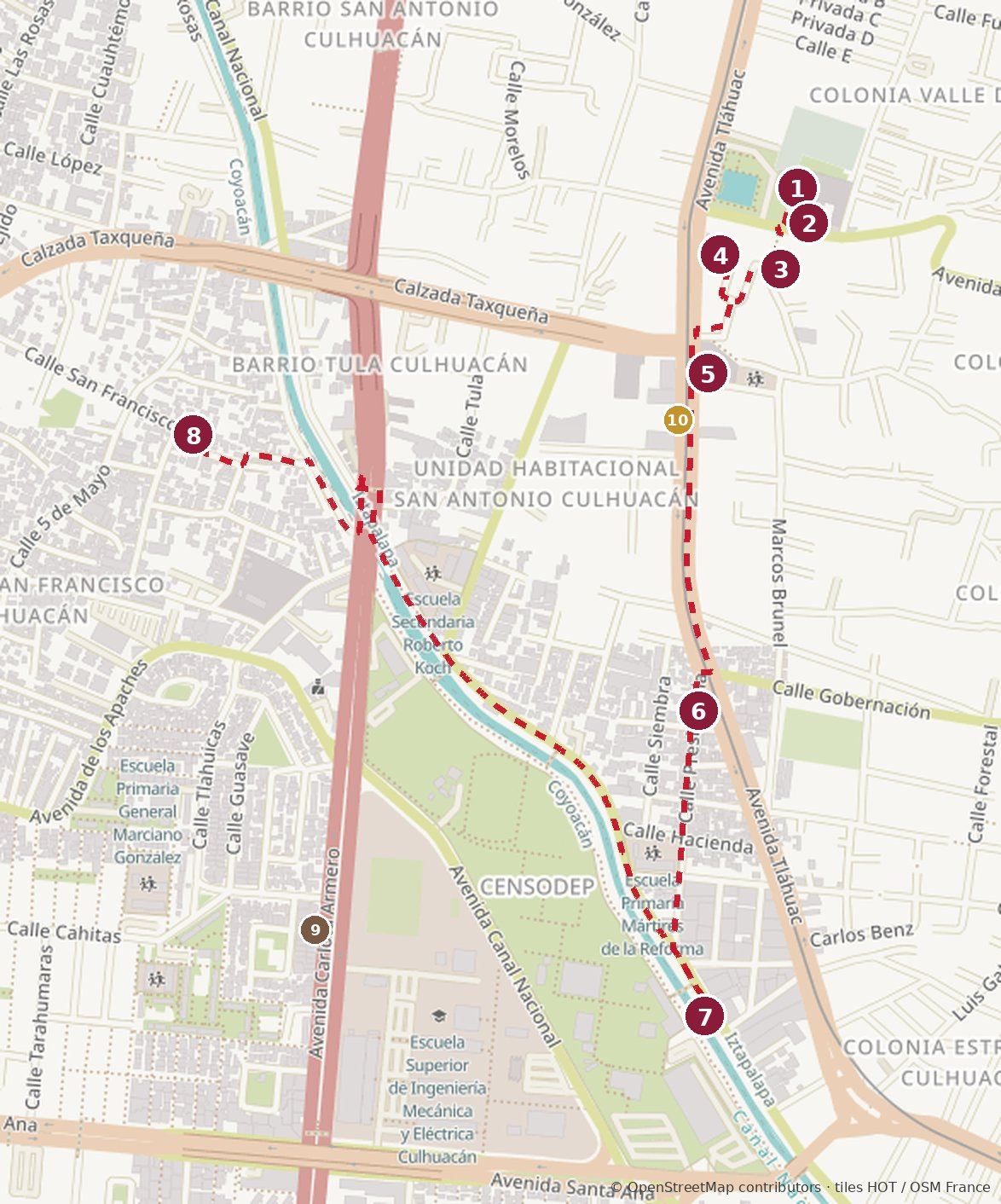
Coffee 9Café del Alma
Bakeries 10Panadería Av. Tláhuac 481
Click to enlarge. Map data © OpenStreetMap contributors.
| # | Stop | What it is |
|---|---|---|
| 1 | Ex-convento de San Juan Evangelista | Augustinian convent, murals, museum |
| 2 | Parroquia de San Juan Evangelista | 19th-century parish church |
| 3 | Santuario del Señor del Calvario | Chapel of the eleven barrios |
| 4 | Molino de papel | Remains of a 16th-century paper mill |
| 5 | Mercado de Culhuacán | Neighborhood market |
| 6 | Rectoría de San Simón Apóstol | Barrio church on Av. Tláhuac |
| 7 | Canal Nacional | Last of the old canal |
| 8 | Parroquia de San Francisco de Asís | Church of San Francisco Culhuacán |
The walk, part 1: the convent and the pueblo
The first half stays within a few blocks of the convent: the museum, the churches, the mill and the market.
Before you start: Cafetería Jireh (Calle Cuauhtémoc 12b, Los Reyes), about eight minutes north of the convent, does coffee, baguettes and croissants (brown circle on the map). After this there is no proper coffee until the afternoon.
1. Ex-convento de San Juan Evangelista
Morelos 10 · Tue–Fri 10:00–17:00 · free
Give it at least an hour. The two-story convent is built of dark volcanic stone around a cloister, and the murals are the reason to come: 16th- and 18th-century paintings by local tlacuilos of Augustinian saints and martyrs, the life of Christ, geometric borders with pre-Hispanic patterns, and a polychrome “Thebaid”, a desert-hermit scene painted as a landscape of water, because that is what the painters saw out of the window. Upstairs are the friars’ cells, one furnished as it would have been, and the domestic chapel.
The small museum, in four rooms opened in 1995, covers the city-state, its Toltec and Mexica connections and the Augustinians. Look for a brazier shaped like a maguey with 52 chalchihuites, probably used in a New Fire ceremony, and a stone Chicomecóatl, goddess of maize. The roofless old church, with the stumps of its columns, stands beside it; the atrium is now the neighborhood cemetery.
Behind is the Parque Histórico, with a pond, a spring the neighbors hold sacred, and the original stone stairway down to a pre-Hispanic boat landing. The lake is long gone, but the stairs still go down to where the water was. The center runs free workshops and draws about 4,000 visitors a month, nearly all of them local.
2. Parroquia de San Juan Evangelista
Morelos 40 · Mon–Fri 10:00–13:30 and 16:00–19:00 · free
A minute or two along Morelos is the parish church that replaced the old one, built at the end of the 19th century from stones of the 16th-century church next door. It is small and often shut outside those hours. Visitors mention painted walls inside; if the door is open, look in.
3. Santuario del Señor del Calvario
Cerrada 16 de Septiembre 11 · check hours · free
A small chapel a couple of minutes south, and the one that matters most to the pueblo. On August 6 the feast of the Señor del Calvario brings all eleven barrios of Culhuacán together here, and neighbors say the night celebrations are bigger than the daytime ones. INAH lists it as a historic building.
4. Molino de papel
Av. Tláhuac at 15 de Septiembre · usually locked; view through the railings · free
Walk about two minutes west to Avenida Tláhuac. Here, according to INAH, are the remains of what was probably the first paper mill in the Americas, built by the Augustinians because they had water and no paper. What is left are low stone walls and channels in a small fenced plaza. Visitors say you reach it through the gate of a group of houses on the street off the market, and that a neighbor keeps the keys, so most people see it through the bars. If you collect old paper, this is probably where paper in the Americas starts.
Carnitas: Los Tres Hermanos (Av. Tláhuac 1616, daily 10:00–18:00) is next door to the mill. It is small and busy and most people order to take away. The order of chamorro comes with pork bones and a quesadilla; carnitas are sold by the kilo. There is no parking and not much room. If you eat here, eat lightly and save room for Carnitas Luchonas further on.
5. Mercado de Culhuacán
Av. Tláhuac at Calle Cuauhtémoc · check hours (daytime) · free
The pueblo’s everyday market, about three minutes south, next to the Metro. It is for groceries, not souvenirs, but walk through for the fondas and the fruit stalls, and look at what people are buying for the next fiesta.
Bakery stop: the neighborhood panadería at Av. Tláhuac 481, just south of the market, sells pan dulce and donuts (gold circle on the map).
The walk, part 2: Avenida Tláhuac to San Francisco Culhuacán
The second half follows Avenida Tláhuac south to the canal, with lunch on the way, then crosses west into Coyoacán for coffee and one last church.
6. Rectoría de San Simón Apóstol
Av. Tláhuac 831 · Mon–Tue and Thu–Fri 10:00–13:00 and 16:00–19:00, Sat 10:00–13:00, closed Wed · free
Walk about six minutes south on Avenida Tláhuac. A modest barrio church right on the avenue, and the seat of one of Culhuacán’s patron saint fiestas, which neighbors recommend as a good first one if you have never been to a pueblo fiesta. Saint Simon’s day is October 28.
Lunch: Carnitas Luchonas (Av. Tláhuac 32, between Agrario and Carlos Benz; Mon 9:00–17:00, Tue–Sun 10:00–16:00) is on the avenue about three minutes further south, on the way to the canal. The tacos weigh over 150 grams each, on a double tortilla with a spare one on top, and one is a meal, at about 30 pesos (~1.60 USD). Order maciza, or maciza with chicharrón. The line is for takeaway; you can usually sit straight down. Sundays are busiest. The alternative is Los Tres Hermanos, back by the mill.
7. Canal Nacional
Canal Nacional at Av. Tláhuac · open space; daylight only · free
A couple of minutes past the tacos, the avenue crosses the Canal Nacional, the last stretch of the water route between the southern lakes and the city. The convent’s water entrance at stop 1 was on a channel off this canal. The city has been rebuilding its banks as a linear park, with paths for walking and cycling; neighbors say the finished sections are very good and other parts are still under works.
From here it is about 17 minutes north-west to the last stop, crossing the canal into Coyoacán. Follow the map. Keep to the path while other people are on it; otherwise take the street.
Coffee break: Café del Alma (Av. Carlota Armero 421, CTM Culhuacán V; Mon–Fri 13:00–21:00), about five minutes off the route in the CTM Culhuacán housing estates (brown circle on the map). It is the best coffee on the walk, and nearly the only specialty coffee: a small bar with friendly baristas, cold brew that will wake you up, chai and mochas, and a few things to eat. Closed weekends.
Late lunch: Cafetería Nacional (Av. Arneses 550D, Barrio Tula; Mon–Sat 7:00–23:00, Sun 7:00–22:00), a few minutes before the church. A big, plain family restaurant of the old kind, with large plates of standard Mexican food, friendly service and prices in the middle. Good after the tacos have worn off, or for breakfast if you do the walk backwards.
8. Parroquia de San Francisco de Asís
San Francisco 24, San Francisco Culhuacán · Mon and Wed–Fri 10:00–14:00 and 17:00–19:00, Sat 10:00–14:00, Sun 7:45–20:00, closed Tue · free
End across the borough line in San Francisco Culhuacán, Coyoacán’s own pueblo originario. The church sits on a narrow street that fills up on fiesta days and at Sunday mass, and the neighbors’ fireworks go off so often that some of them complain about it online. When you are done, call an Uber from the corner.
Coffee, food and drink
For coffee, go to Café del Alma; for lunch, carnitas at Carnitas Luchonas or Los Tres Hermanos; for a sit-down meal, Cafetería Nacional.
| Place | What | Where |
|---|---|---|
| Café del Alma | Specialty coffee, cold brew | Av. Carlota Armero 421, between stops 7 and 8 |
| Lugarcito Café | Coffee, desserts, chiles en nogada in season | Remedios Valle 95A, south-west of stop 7 |
| Cafetería Jireh | Coffee, baguettes, croissants | Calle Cuauhtémoc 12b, Los Reyes, north of stop 1 |
| Panadería, Av. Tláhuac 481 | Neighborhood bakery, donuts | Near stop 5 |
| Los Tres Hermanos | Carnitas, chamorro | Av. Tláhuac 1616, next to stop 4 |
| Carnitas Luchonas | Giant carnitas tacos | Av. Tláhuac 32, between stops 6 and 7 |
| Carnitas Don Pepe | Carnitas, quesadillas, weekends only | 2a Privada Vicente Guerrero 19, near stop 5 |
| Chamorros El Dorado | Chamorros, family lunches | Av. Tláhuac 324, north of stop 1 |
| Mercado de Culhuacán | Fondas | Stop 5 |
| Cafetería Nacional | Mexican breakfasts and comida | Av. Arneses 550D, near stop 8 |
If you just want a familiar cup, there are no chain cafés on the route. The nearest are:
- Pastelerías Esperanza at Av. Tláhuac 429 A, near stop 5 (bread, not coffee)
- Pastelerías Esperanza at Calzada de Taxqueña 1889, west of the finish, with coffee inside
- Starbucks at Portal Lomas Estrella, on Avenida Tláhuac about 2 km south-east of stop 7
Shops worth the detour
Culhuacán is not a shopping trip. What there is to buy is food.
- Mercado de Culhuacán (stop 5): fruit, chiles, flowers and fiesta supplies.
- Los Tres Hermanos (next to stop 4): carnitas by the kilo, if you are going home to a kitchen.
- Mercado San Francisco Culhuacán: a large daily market on Eje 2 Oriente, about ten minutes west of the finish (daily 9:00–18:00).
- Pastelerías Esperanza (near stop 5): a bag of pan dulce for the ride back.
Which day to walk
Wednesday to Friday gets you the most; weekends and Mondays the least. Only the stops with limited days are listed below.
| Stop | Mon | Tue–Fri | Sat | Sun |
|---|---|---|---|---|
| 1 Ex-convento | Closed | 10:00–17:00 | Closed | Closed |
| 2 San Juan Evangelista | Open | Open | Closed | Masses only, check |
| 6 San Simón Apóstol | Open | Closed Wed | Mornings | Masses only |
| 8 San Francisco de Asís | Open | Closed Tue | Mornings | Open |
On a weekend, the convent and Café del Alma are closed and Carnitas Luchonas has its longest line, so save Culhuacán for a weekday and go to Tlalpan or Coyoacán instead.
Keep walking
Culhuacán is a long way from the other walks in this series, so these are short add-ons by car.
East: the Cerro de la Estrella and the Museo del Fuego Nuevo. The museum is near the top of the hill, about 2 km and a steep climb from the convent, so take a taxi up rather than walking. It is a single room on the New Fire ceremony, with a small cave and an outdoor area, free, Tue–Sun 10:00–17:00. Neighbors recommend the quesadillas across the road on weekends. Go in the morning and with company if you want to walk the trails to the temple platform on the summit.
North: Los Reyes Culhuacán. The Parroquia de los Santos Reyes, Benito Juárez 4, is about ten minutes north of the convent along Avenida Tláhuac, past Chamorros El Dorado. Don’t hang around in the plazuela beside it.
West: Coyoacán. From the finish, Coyoacán’s center is about 20 minutes by car.
About the author and where to stay
Brian has lived in Roma Norte for about five years and writes the See Mexico City guides. He speaks seven languages and still gets lost on purpose.
When you visit, stay with us at Penthouse El Cielo de Roma in Roma Norte.
Photo credits
Photos via Wikimedia Commons, used under the licenses shown. Numbers match the captions.
Map: drawn from OpenStreetMap data, © OpenStreetMap contributors, Open Database License.
Sources
Hours and prices checked October 2026; confirm before you go.
- INAH: Ex Convento de Culhuacán, visitor guide (English)
- INAH: Ex Convento de Culhuacán, visitor guide (Spanish)
- INAH: Museo de sitio Culhuacán, guide
- INAH: Ex Convento de San Juan Evangelista exhibition
- INAH: Boletín 499, August 2024
- INAH, Rutas de Campo: article on the convent of Culhuacán
- INAH, Gaceta de Museos: article on the Centro Comunitario Culhuacán
- Mexico City tourism: Exconvento de San Juan Evangelista
- CDMX Secreta: Ex conventos en CDMX
- Posta: Este centro ceremonial en CDMX tiene más de mil años (April 2025)
- N+: Qué hacer gratis en los Barrios Mágicos de CDMX