Far West: Cuajimalpa on Foot
Why Cuajimalpa
Cuajimalpa is the old mountain town behind Santa Fe. Ten minutes from the glass towers there is a red stone church begun in 1628, a garden with a kiosk where the churchyard used to be, a 1960s market, a museum full of Pedro Infante’s things and another about Miguel Hidalgo, who slept here after his biggest battle. It is cooler than the rest of the city, often by a jacket.
The town is properly called San Pedro Cuajimalpa. It sits on the old road from Mexico City to Toluca, at about 2,700 meters, on the western edge of the city, with the Desierto de los Leones forest to the south. The center is small. Everything that matters is within a few blocks of the Jardín Hidalgo and the borough hall.
This walk suits people who have done the Centro, Roma and Coyoacán and want to see what a pueblo inside the city looks like on a normal day. It is not a pretty colonial town in the Coyoacán sense. Traffic and microbuses crowd Avenida Juárez, sidewalks are narrow, and the walk ends on a busy avenue of chain stores. The church, the garden and the food are worth it.
Practical basics
The walk is about 3.3 km, one way, and takes half a day with stops. It is a long way from Roma Norte: allow 45 minutes to an hour each way by Uber or taxi, more in rush hour. Take a car to the start and call one at the end. Do it on a Saturday.
| Start | Didara Cuajimalpa (bakery), Prolongación Av. Juárez 363, Las Tinajas; stop 1 is a 14-minute walk west |
| Finish | La Casa de la Tía (lunch), Av. José María Castorena 351, near the Starbucks at Castorena 320 |
| Distance | About 3.3 km; roughly 45 minutes of pure walking. The seven stops themselves sit within 1 km |
| Time needed | 3–4 hours with coffee, two museums and lunch |
| Best day | Saturday: the museums, the taquería, both cafés and the market are open, and the garden fills up |
| Avoid | Monday, when the Museo Pedro Infante is closed, and Wednesday, when El Condorito is |
| Toilets | Buy something: Didara, Il Cafetto and La Casa de la Tía all have them. The garden has none |
There is no Metro in Cuajimalpa. If you use public transport, the nearest rail is the Santa Fe station of the El Insurgente train to Toluca, about 2 km from the start; a taxi from there takes a few minutes. Buses from Metro Observatorio also run along the Mexico–Toluca highway to Cuajimalpa.
If you are short of time, skip Didara and start at the fountain on Juárez and Coahuila. That saves a kilometer. If you start late, eat first at El Condorito and keep La Casa de la Tía for a coffee.
Cuajimalpa is a working town and feels safe in daylight. The danger here is traffic: microbuses stop wherever they like at Juárez and Veracruz, so cross at the lights and walk single file where the sidewalk shrinks. Bring a sweater; it can be several degrees colder than Roma.
A short history
The name comes from the Nahuatl Cuauhximalpan, roughly “on the wood chips”, a place where wood was cut and worked. Tepanecas from Azcapotzalco settled the forest around 1342 and held it until the Mexica took the region in the 15th century. In 1534 Hernán Cortés took the lands for himself as San Pedro Cuauhximalpa, and the road to the Toluca valley through here became a toll road. Benito Juárez closed the toll booth in 1860.
Around the end of the 17th century the townspeople had a codex painted in Nahuatl to prove their right to the land, the Códice Techialoyan de Cuajimalpa. It stayed a valid legal document until 1865, when Emperor Maximilian had it translated into Spanish. UNESCO put it on its Memory of the World register in 1997. The original is in the national archives; a copy is in the borough hall.
The church of San Pedro was begun around 1628 and inaugurated on 15 February 1755, with one tower added in 1785. On 30 October 1810 Hidalgo’s insurgent army beat the royalists at Monte de las Cruces, in the mountains just west of town. Hidalgo stayed in Cuajimalpa afterwards, and it is here that he is said to have decided not to march on the capital. It was probably the most expensive decision of the war.
Cuajimalpa became a municipality in 1862 and a borough of the Federal District in 1928–29. The municipal palace and the Jardín Hidalgo were built in 1900. From 1912 an electric train ran from Santa Fe to La Venta, until 1953. The market opened in 1962, and in 1970 the borough added “de Morelos” to its name. Pedro Infante filmed scenes of his 1947 García comedies at the church, and he had a house on the Toluca highway. Lupe Pintor, twice a WBC world boxing champion, was known as “El Grillo de Cuajimalpa”.
Then Santa Fe happened. From the 1990s a business district grew up on the old landfills to the east, and the town became a place people drive past on the way to the offices. Cuajimalpa is one of the city’s Barrios Mágicos, a title the city government started giving in 2011. In February 2026 the El Insurgente train finally reached Observatorio, so you can now ride from Santa Fe to Toluca in about half an hour.
The route
The walk runs one way. After breakfast at a bakery in Las Tinajas, it follows Avenida Juárez west to the old fountain, takes in the market, the borough hall, the church, the garden and the cultural center, and then walks north-east to Castorena for lunch. There are 7 numbered stops, all close together in the center; the coffee and the lunch are at either end. Follow it on the Cuajimalpa on Foot map, which shows every stop, the walking route, the cafés and bakeries and the nearest chain cafés.
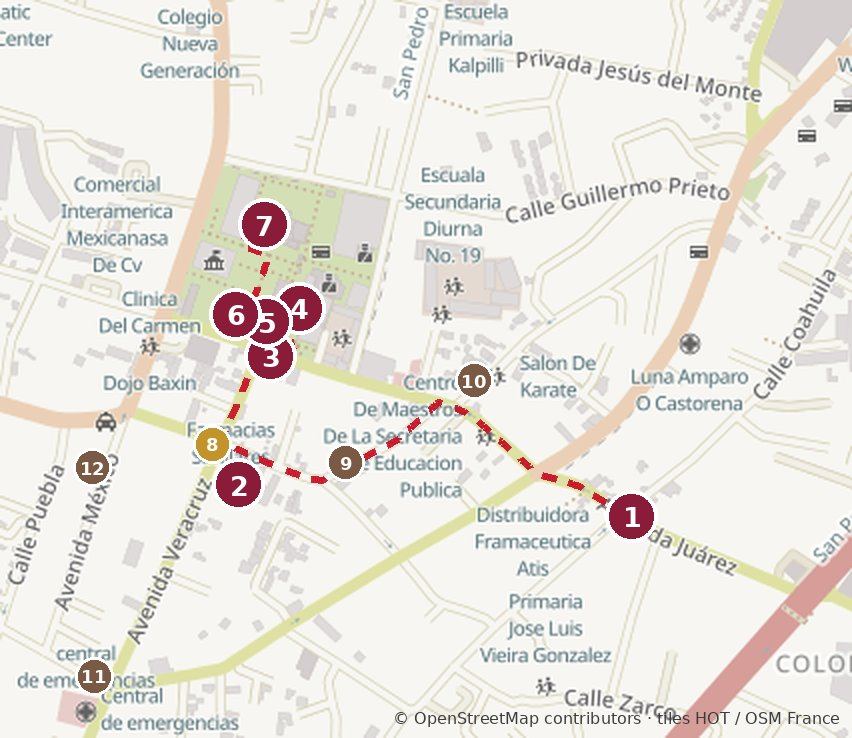
Coffee 9El Encuentro · 10Il Cafetto · 11Gladys's Coffee · 12Café D' Luis
Bakeries 8Lecaroz Cuajimalpa
Click to enlarge. Map data © OpenStreetMap contributors.
| # | Stop | What it is |
|---|---|---|
| 1 | The 1902 fountain | Stone fountain on the old road |
| 2 | Mercado Cuajimalpa | 1962 market |
| 3 | Museo Miguel Hidalgo | Small history museum |
| 4 | Parroquia de San Pedro Apóstol | 17th-century parish church |
| 5 | Jardín Hidalgo | Garden and kiosk |
| 6 | Museo Pedro Infante | Museum of the film star |
| 7 | Centro Cultural Cuajimalpa and Teatro Morelos | Cultural center and murals |
The walk, part 1: Las Tinajas to the church
The first half is breakfast and the old road: a kilometer of Avenida Juárez, a fountain, the market, then the borough hall and the church.
Breakfast: Didara Cuajimalpa (Prolongación Av. Juárez 363, Las Tinajas), where the walk starts (gold circle on the map). A small bakery-café that the city tourism office singles out for its conchas and croque madame. Get a coffee and something sweet before you set off. Mon and Wed–Sat 9:00–18:00, Tue 8:30–18:00, Sun 9:00–15:00.
1. The 1902 fountain
Av. Juárez at Coahuila · open space · free
From Didara, walk about 14 minutes west along Juárez to the corner of Coahuila. Avenida Juárez is the oldest road in Cuajimalpa, the route to Toluca before the highway, and this stretch still has some of the town’s old houses. Look for the one with a tiled gable roof. The stone fountain in front of it was put there by the local government in 1902, when water from the Desierto de los Leones had only just arrived by pipe.
2. Mercado Cuajimalpa
Av. Veracruz 40 · daily 8:00–16:30 · free
Walk about seven minutes west to Avenida Veracruz and the market, opened in 1962 and the oldest in the borough. It began as a tianguis selling mostly charcoal and firewood, which tells you how this town made its living. It stands on the site of an old inn for travelers on the Toluca road. Hidalgo is said to have stayed in a Cuajimalpa inn, the Mesón San Luisito, after the battle; I could not confirm it was this one. The fondas inside serve mole de olla, enchiladas verdes gratinadas and milanesa with fries. Every year the image of San Pedro is carried in procession through the aisles.
Tacos and bread: Taquería El Condorito (Av. Veracruz 39) is right across the street. It is the traditional taquería of Cuajimalpa: suadero, pastor, barbacoa, flautas, consomé and beer in a frosted mug. Tables are shared, and nobody waits for a free one. If you want the tripa, come in the morning; it sells out. Thu–Tue 8:00–18:00, closed Wed. A few doors up, Lecaroz (Av. Veracruz 29, gold circle on the map) is the big panadería in the center, open 6:00–21:30, and El Encuentro (Tamaulipas 129, brown circle on the map) is a couple of minutes east if you want a coffee.
3. Museo Miguel Hidalgo
Inside the borough hall, Av. Juárez s/n · check hours · free
Walk two minutes north up Veracruz to the borough hall. Inside is a small museum founded in 2000 about Hidalgo and the history of the town. It has copies of the Techialoyan codex, letters of Hidalgo, sketches of insurgents and paintings of the war. It is a few rooms, not a day out. The building itself is the old municipal palace of 1900.
4. Parroquia de San Pedro Apóstol

Av. Juárez s/n · daily 7:00–19:00 · free
The church is a minute away, next to the borough hall. It was begun around 1628 and inaugurated in 1755, though work went on: an inscription on the central arch gives 1818, the left tower is from 1785, and the church only became a parish in 1946. The facade is red tezontle stone under a neoclassical frieze of metopes and triglyphs, which is not what you expect on a village church. Inside, on the main altar, Saint Peter stands within a carved cedar tree. Pedro Infante filmed scenes of Los tres García here in 1947, and people in town will tell you so.
During Holy Week, Cuajimalpa stages a Passion play that has run since the late 19th century and draws more people than any in the city except Iztapalapa’s. On Holy Saturday they hang a Judas. The patron saint’s day is 29 June.
The walk, part 2: the garden to Castorena
The second half covers the garden, the Pedro Infante museum and the cultural center, then walks out to Castorena for coffee and lunch.
5. Jardín Hidalgo
Av. Juárez at Veracruz, in front of the borough hall · open 24 hours · free
Step out in front of the church. The garden was its atrio, the churchyard, until 1900, when it was laid out with the old municipal palace. It has two roundabouts, benches, old trees and a kiosk, and it is where Cuajimalpa meets. Carnival starts here on the Saturday before Ash Wednesday, with the Huehuenches, men dressed as women, dancing a tradition that has run for over 70 years. On other weekends you may find a taco fair or live music.
6. Museo Pedro Infante
Av. Juárez at Veracruz, facing the garden · Wed–Sun 10:00–17:00; check hours · free
Cross the garden. The building covered in giant photographs is the museum of Pedro Infante, the singer and actor most Mexicans over 50 still call the idol of the people. It opened in 2015 with some 500 objects donated by his family, many from his house at kilometer 18.5 of the Toluca highway: his car, a replica of the robe he wore as Pepe el Toro, costumes, posters, his radio and his typewriter. There is an altar where visitors leave him messages, and two small rooms that show his films for free. The open-air Foro Pedro Infante next to it hosts concerts in spring and summer.
7. Centro Cultural Cuajimalpa and Teatro Morelos
Guillermo Prieto s/n, beside the borough hall · check hours · free
Two minutes north, behind the borough hall, is the town’s cultural center, open since 1992, with the Teatro Morelos next door. The theater seats about 400. Go in to see the murals: a very large one of the Battle of Monte de las Cruces, and another from 1982 that runs through Mexican history from antiquity to the fall of Tenochtitlan. The center also holds a library, a small gallery and classes in dance, music and martial arts.
Coffee break: Il Cafetto (Tamaulipas 13), about six minutes south-east (brown circle on the map). A small two-floor café with crepes, cakes and sandwiches. One reviewer called it Parisian, which is generous, but the cappuccino is good and it is the best place in the center to sit for half an hour. Mon–Sat 8:00–22:00, closed Sun.
Lunch: from Il Cafetto, walk about eight minutes north-east up Castorena to La Casa de la Tía (Av. José María Castorena 351). It serves a three-course comida corrida, soup, rice or pasta and a main, for under 100 pesos (~5 USD), plus breakfasts and a long menu of enchiladas and grilled meat. The city tourism office recommends the pechuga florentina. Daily 8:00–18:00. The alternative is on the way, three or four minutes from Il Cafetto: Carnitas El Juanito (Av. José María Castorena 204), a small stand that people in Cuajimalpa defend. Order maciza, cuerito and costilla by weight or in tacos, with red and green salsa and onion with chile. One regular’s advice on Google is not to go after 15:00. I would take it. Daily 9:00–17:00. The Starbucks at Castorena 320 is around the corner from La Casa de la Tía, and so is your Uber.
Coffee, food and drink
For coffee, go to Didara or Il Cafetto; for lunch, La Casa de la Tía, El Juanito or the market fondas; for something sweet, Pan de Elia.
| Place | What | Where |
|---|---|---|
| Didara Cuajimalpa | Bread, coffee, breakfast | Prolongación Av. Juárez 363, the start |
| Il Cafetto | Coffee, crepes, cake | Tamaulipas 13, between stop 7 and lunch |
| Pan de Elia | Small bakery, café de olla, cinnamon rolls | Carr. México–Toluca 5780, near the start |
| Lecaroz | Panadería, 6:00–21:30 | Av. Veracruz 29, by stop 2 |
| Café Ancona | Café with art on the walls, rompope cappuccino; mostly evenings | Antonio Ancona 19, near the finish |
| Taquería El Condorito | Tacos, consomé, beer | Av. Veracruz 39, across from stop 2 |
| Market fondas | Mole de olla, enchiladas, milanesa | Stop 2 |
| Carnitas El Juanito | Carnitas | Av. José María Castorena 204 |
| Barbacoa | Barbacoa with handmade tortillas | Av. Veracruz 57, near stop 2 |
| Quesadillas Mary | Quesadillas, evenings only | Guillermo Prieto 57, near stop 7 |
| El Garnachero Express | Gorditas, chilaquiles, aguas frescas | Guillermo Prieto 20, near stop 7 |
| Antojería El Sarape | Antojitos made to order | Near the finish on Castorena |
| La Casa de la Tía | Comida corrida | Av. José María Castorena 351, the finish |
If you just want a familiar cup, the chains sit at the edges of the route:
- Starbucks Plaza Cedros at Carr. México–Toluca 5780, near the start
- Starbucks Castorena at 2a Cerrada de Castorena 320, by the finish
- Cielito Querido at Juan Salvador Agraz 97 (Paragon) and Vasco de Quiroga 3800, in Santa Fe
Shops worth the detour
Cuajimalpa has no shopping street for visitors. Avenida Veracruz is where locals do their errands, and the rest is food.
- Mercado Cuajimalpa (stop 2): produce, chiles, flowers and prepared food.
- Didara, at the start: a bag of bread for the ride home.
- Lecaroz at Av. Veracruz 29: the big panadería in the center, open 6:00–21:30.
- Holy Week fair: during Semana Santa the Feria de Cuajimalpa sells crafts, jewelry and food from around the country.
Which day to walk
Saturday gets you the most; Monday the least. Only the places with limited days are listed below.
| Place | Mon | Tue–Fri | Sat | Sun |
|---|---|---|---|---|
| Didara | Open | Open | Open | Until 15:00 |
| 2 Mercado | Until 16:30 | Until 16:30 | Until 16:30 | Until 16:30 |
| El Condorito | Open | Closed Wed | Open | Open |
| 6 Museo Pedro Infante | Closed | Wed–Fri (Google also lists Tue) | Open | Open |
| 7 Centro Cultural | Check | Check | Check | Check |
| Il Cafetto | Open | Open | Open | Closed |
On a Sunday, have coffee at Didara before 15:00 and skip Il Cafetto. On a Wednesday, eat at the market instead of El Condorito.
Keep walking
Cuajimalpa is the gateway to the city’s western forests. None of these are walkable from the finish, so take a taxi.
South: the Desierto de los Leones. The Carmelite monastery stands about 5 km south of the town as the crow flies, further by road. The friars laid the first stone in 1606; the present building was finished in 1814, and in 1917 Venustiano Carranza made the forest around it Mexico’s first national park. Go in the morning, check the convent’s hours, and stay for lunch at the stalls near the entrance.
West: La Marquesa. Further along the Toluca highway is the Parque Nacional Insurgente Miguel Hidalgo y Costilla, which marks the site of the 1810 battle. There are bronze equestrian statues of Hidalgo, Allende and Jiménez, horses to rent and trails into the Valle del Silencio. On weekends it is a family picnic ground.
East: Santa Fe. The towers, the malls and the El Insurgente station are ten minutes away by car. Ride the train to Toluca and back for the view of the pine forest.
About the author and where to stay
Brian has lived in Roma Norte for about five years and writes the See Mexico City guides. He speaks seven languages and still gets lost on purpose.
When you visit, stay with us at Penthouse El Cielo de Roma in Roma Norte.
Photo credits
Photos via Wikimedia Commons, used under the licenses shown. Numbers match the captions.
- Parroquia de San Pedro Apóstol, Pueblo de San Pedro Cuajimalpa.jpg, CHIMPERINO, CC BY-SA 3.0
Map: drawn from OpenStreetMap data, © OpenStreetMap contributors, Open Database License.
Sources
Hours and prices checked October 2026; confirm before you go.
- Mexico City tourism: San Pedro Cuajimalpa, Mercado Cuajimalpa, Centro Cultural Cuajimalpa, Museo Miguel Hidalgo y Costilla, Desierto de los Leones convent
- Mexico City tourism: Cuajimalpa, sabores del bosque
- INAH, Catálogo Nacional de Monumentos Históricos: Parroquia de San Pedro Apóstol
- Sopitas: Pequeño homenaje al Jardín Hidalgo de Cuajimalpa
- Sopitas: Museo de Pedro Infante en CDMX
- Chilango: Museo Pedro Infante, la casa del ídolo del pueblo
- Chilango: Barrios mágicos en CDMX
- Escape to Mexico: Centro de Cuajimalpa
- Magical Towns: Museo de Pedro Infante
- Wikipedia: Cuajimalpa, Techialoyan Codex of Cuajimalpa, Desierto de los Leones National Park, La Marquesa National Park
- Kiddle: San Pedro Cuajimalpa
- Hispanopedia: Parroquia de San Pedro Apóstol (Cuajimalpa), Cuajimalpa de Morelos
- Crónica: Dónde está la estación Santa Fe del Tren El Insurgente
- N+: Lista de los Barrios Mágicos de la CDMX