Inner West: Juárez incl. Zona Rosa on Foot
Why Juárez
Colonia Juárez is the wedge of city between Paseo de la Reforma, Avenida Bucareli and Avenida Chapultepec. It was built around 1900 for diplomats, foreign businessmen and Porfirio Díaz’s ministers, who wanted mansions with front gardens a short carriage ride from the center. Most of them left after the Revolution. What they left behind is still here, in pieces: French-roofed houses on Berlín and Versalles, a 1907 hotel, a Chinese clock, a palace that has housed the Interior Ministry since the Revolution, and one of the first apartment complexes in the city.
The Zona Rosa is one corner of it, 24 of the colonia’s 99 blocks, west of Insurgentes. It was the bohemian quarter of the 1960s and became the center of gay Mexico City. Inside the Zona Rosa, on the streets around Hamburgo, Florencia, Varsovia and Praga, is Pequeño Seúl, Little Seoul. The streets are named after European cities: Londres, Berlín, Hamburgo, Havre, Génova, Amberes (Antwerp), Praga. The rest, east of Insurgentes, is quieter and has most of the architecture.
This walk suits people who have done Roma and Condesa and want to see what the city looked like before them. It crosses the whole colonia, from Bucareli to Little Seoul, and ends where you can eat Korean food. It is not pretty everywhere. Bucareli is loud and often blocked by protests, Génova has flyer touts, and plenty of the old houses are empty, propped up or turned into parking. I like it anyway.
Zona Rosa
The Zona Rosa began as a subdivision for the rich, begun by Rafael Martínez de la Torre before his death in 1882, and turned into something else in the 1950s, when painters and writers moved into the half-empty mansions. Galleries opened from the late 1950s. Rufino Tamayo, Francisco Toledo, Leonora Carrington, Lilia Carrillo and Manuel Felguérez showed here, and so did José Luis Cuevas, the loudest of the Generación de la Ruptura, the young painters who broke with the Mexican muralists. In 1959 the Pasaje Jacaranda opened on Génova, with Le Bistrot and La Trucha Vagabunda, and Carlos Monsiváis, Cuevas and Alejandro Jodorowsky among the regulars. By 1965 the Zona Rosa was the place to be seen; Luis Buñuel, Homero Aridjis and the writers of the Latin American Boom drank in its cafés. At Café Tirol the mime Alfonso Arau met Monsiváis, and the two put together a satirical rock show, Los Tepetatles, with sets by Cuevas and Vicente Rojo. Café Kineret was another of their places. The neighborhood even had its own literary magazine, called Zona Rosa.
Who named it is argued over. Cuevas claimed the name and said the area was too innocent to be red and too frivolous to be white. Vicente Leñero, the journalist Agustín Barrios Gómez and Carlos Fuentes also get the credit; Fuentes wrote about its pink-painted houses in La región más transparente (1958). On 8 June 1967 Cuevas put up his Mural efímero on a rooftop where Londres 107 now stands, near Génova, a painting meant to last a few weeks, as a jab at Siqueiros and the muralists.
Metro construction began in 1968, the Glorieta de los Insurgentes opened in 1969, and the area lost its exclusive feel. The 1980s crisis and the 1985 earthquake did the rest. Galleries, jewelers and boutiques left, Café Tirol closed, and men’s clubs, massage parlors and souvenir shops moved in.
At the same time the Zona Rosa became the center of gay Mexico City. On 23 January 1977 a Frenchman, Henri Donnadieu, and his partner Manolo Fernández turned their French restaurant at Londres 156, Le Neuf, into El 9, the first openly gay bar in the country. Monsiváis, Pita Amor and Silvia Pinal were regulars, and Caifanes and Café Tacvba played its stage. The police closed it on 6 December 1989 on a false drug charge and jailed the staff. In June 1979 about a thousand people walked the first gay pride march in Mexico City, from the Ángel; the police would not let them use Reforma. Through the 1990s the bars settled on Amberes, and by the 2000s there were more than 200 gay businesses in the Zona Rosa. The Pride march now goes down Reforma past the Ángel every June. Donnadieu died in August 2025. In 2026 the city made Amberes semi-pedestrian, and the street is still the heart of it.
Pequeño Seúl (Little Seoul)
Koreans first came to Mexico in 1905. More than a thousand men, women and children sailed from Incheon on 4 April 1905, landed at Salina Cruz on 8 May and went on by train to Progreso, to work on the henequen plantations of Yucatán on four- and five-year contracts. Conditions were harsh, few could save the fare home, and in 1910 Japan annexed Korea and left them stateless. Most stayed. Many married into Maya families, and their descendants are counted in the tens of thousands.
Mexico and South Korea set up relations in 1962, but numbers stayed small until the late 1980s. In the early 1990s there were fewer than 600 Koreans in the capital. Then came the big wave of business owners, traders and workers sent by companies like Daewoo, and after the 2001 crisis in Argentina, Korean families from there. The Korean community in Mexico peaked at about 19,500 in 1997, and Mexico City has an estimated 9,000 to 11,000 Koreans today.
They settled here because it was cheap. The anthropologist Sergio Gallardo García points out that prices in the Zona Rosa collapsed after the 1985 earthquake, when many buildings were abandoned. The community took the blocks around Hamburgo, Praga, Berna, Biarritz, Florencia, Varsovia and Liverpool. On Biarritz nearly nine in ten residents are Korean. Korean Christians founded churches in the 1990s, among the first Korean institutions in the city. The weekend Korean school on Liverpool spent two decades in rented rooms before buying its own building in 2010. Then came groceries, hair salons, saunas, a free Korean newspaper and karaoke rooms (noraebang), many of them with Korean-only signs and, for years, mostly Korean customers.
What changed it was the Korean wave. In the 2000s a State of Mexico TV channel started showing Korean soap operas, and they were an unexpected hit. K-pop did the rest. Now young Mexicans come to Little Seoul for corn dogs, bingsu, BTS albums and karaoke, and the Korean shops play to them. The newest Koreans tend to be students and staff of Korean companies, and Samsung and LG have moved their people to Polanco, where the Korean Cultural Center is. Little Seoul is still where everyone comes to eat.
Practical basics
The walk is about 4 km, one way, east to west, and takes most of a day with stops. Take an Uber or taxi to the start and home from the end. Do it on a weekday or a Saturday, starting around 10:00.
| Start | Glorieta de las Mujeres que Luchan, Paseo de la Reforma at Versalles and Av. Morelos |
| Finish | Parroquia del Santo Niño de la Paz, Praga 11, in Little Seoul |
| Distance | About 4 km; roughly 55 minutes of pure walking |
| Time needed | 4–5 hours with coffee, the markets and lunch |
| Best day | Tuesday to Saturday, when both markets, both churches and the antiques arcade are open |
| Avoid | Sundays, when Mercado Juárez and Plaza del Ángel are closed and the Praga parish shuts at 14:30; Mondays, when both churches are closed |
| Toilets | Café La Habana near the start and El Péndulo on Hamburgo, if you buy something; Mercado Insurgentes charges 5 pesos (~0.25 USD) |
If you come by public transport, Metrobús Line 7 runs along Reforma past the start, and Metro Juárez (Line 3) is about ten minutes’ walk east of it. From the finish, Metro Sevilla (Line 1) is about five minutes south down Praga, and Metro Insurgentes (Line 1) about ten minutes south-east.
If you are short of time, start at Mercado Juárez (stop 5) and skip Bucareli. That saves about 1 km. If you only want the Zona Rosa and Little Seoul, start on Génova (stop 11).
Juárez is fine by day. Bucareli in front of the Interior Ministry is a protest site, sometimes with tents, police lines and the street closed; walk around it if it looks tense. Keep your phone in a front pocket on Génova and around the Ángel, ignore anyone handing out flyers for bars, and check your bill on Génova, where some places add a service charge without saying so. At night, stay on lit streets and take a ride home.
A short history
In the 1860s this was swamp and farmland, part of a hacienda called La Teja. Empress Carlota had a road built from Chapultepec Castle toward the center in 1865; the republic widened it and opened it to the public in 1877 as Paseo de la Reforma, and the land beside it became worth draining. Rafael Martínez de la Torre began a subdivision for wealthy buyers but died in 1882. Four small colonias grew up here (Los Arquitectos, Bucareli, Del Paseo and Nueva del Paseo), and people called the area the Colonia Americana for its foreign residents. In 1906 they were joined as Colonia Juárez. The European street names were suggested by Ricardo García Granados, a former consul, and the rules required front gardens of 10 to 20 meters.
It was one of the first parts of the city with electric light. Porfirio Díaz’s finance minister, José Yves Limantour, lived on Londres, and for a while people called it Colonia Limantour. For the centenary of independence in 1910 the government put up the Ángel on Reforma, China sent a clock for Bucareli, and the United States gave a statue of George Washington for a little plaza on Dinamarca.
The Revolution ended all that. During the Decena Trágica of February 1913, Francisco Madero’s family house at Liverpool 25 was burned and shells hit the Chinese clock. Families who could afford it moved to Lomas, Polanco and Del Valle, and ministries took over their houses. In the late 1930s the exiled Spanish Republic had its embassy in a mansion on Londres. From the 1950s artists and writers moved into the cheap, grand houses west of Insurgentes, and that corner became the Zona Rosa.
The 1985 earthquake hit Juárez hard. It damaged many buildings and wrecked Plaza Washington. Along with the economic crisis, it emptied the colonia; squatters moved into old houses, rents in the old tenements stayed frozen, and the population fell below 9,000 by the early 2000s. The low prices are part of why Korean families settled here.
The colonia today has 31 buildings of historical interest and 120 of architectural interest. New towers keep going up on Reforma. Restaurants, galleries and short-term rentals have moved into the old houses. In 2023 a property portal said rents in Juárez and similar colonias had risen as much as 118 percent over the borough average, and in July 2025 residents of Juárez, Roma and Condesa held a protest against gentrification. Early in 2024 Time Out put Bucareli on its list of the world’s most interesting streets. For the 2026 World Cup the city rebuilt Amberes and restored the sculptures of the Zona Rosa.
The route
The walk runs one way, east to west, from Reforma down Bucareli, across the Porfirian blocks east of Insurgentes, through the Zona Rosa and into Little Seoul, in 16 numbered stops. Coffee and lunch come in between, where you pass them, and the Korean places are listed at the end. Follow it on the Juárez incl. Zona Rosa on Foot map, which shows every stop, the walking route, the coffee places and bakeries, and the Korean restaurants, snack bars and marts.
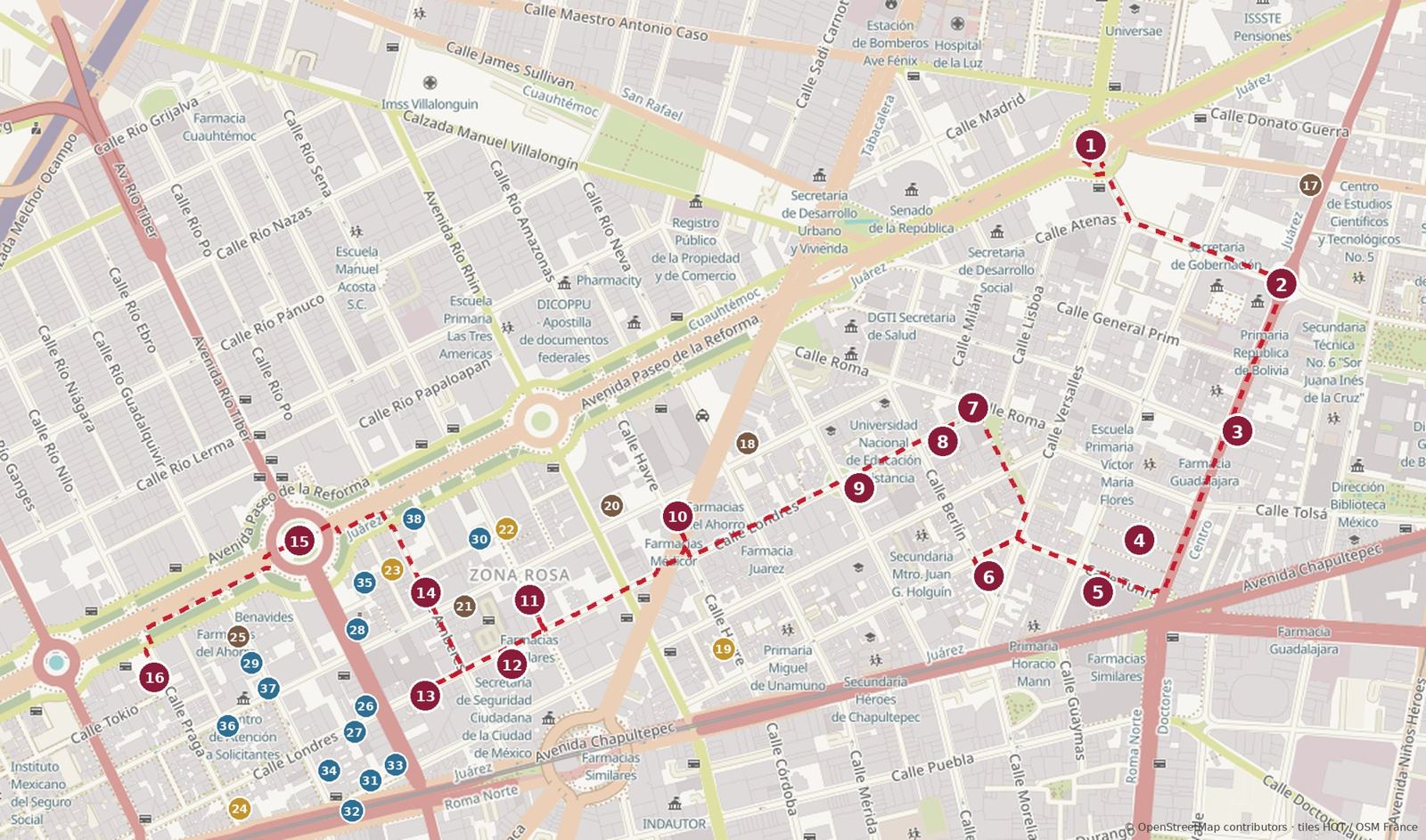
Coffee 17Café La Habana · 18La Valiente · 20The Coffee Hamburgo · 21Cafebrería El Péndulo · 25Dragon Boba & Coffee
Bakeries 19Café Nin · 22Pastelnara · 23O'ppang · 24Baking Story
Korean food 26Min Sok Chon · 27Seoul Restaurante Coreano · 28Biwon · 29Surasang · 30Goguinara · 31Nadefo · 32Mapo Gal Bi · 33Nara Salchicha · 34Song's Recipe · 35O'Mandu · 36Mini Super Coreano · 37Kmart (Korean mart) · 38Oppa Mart
Click to enlarge. Map data © OpenStreetMap contributors.
| # | Stop | What it is |
|---|---|---|
| 1 | Glorieta de las Mujeres que Luchan | Former Columbus roundabout |
| 2 | Reloj Chino and Palacio de Cobián | Chinese clock; Interior Ministry |
| 3 | Edificio Vizcaya | 1920s apartment building |
| 4 | Edificio Mascota | 1913 worker housing |
| 5 | Mercado Juárez | Neighborhood market |
| 6 | Berlín and Versalles | Porfirian mansions |
| 7 | Templo del Sagrado Corazón de Jesús | The colonia’s first church |
| 8 | Museo de Cera | Wax museum in a mansion |
| 9 | Plaza Washington | Small plaza |
| 10 | Casa Diener and Calle Havre | 1907 mansion; the French street |
| 11 | Calle Génova | Zona Rosa’s pedestrian street |
| 12 | Hotel Geneve | 1907 hotel, lobby museum |
| 13 | Mercado Insurgentes | Crafts market since 1955 |
| 14 | Calle Amberes | The gay street |
| 15 | Ángel de la Independencia | 1910 victory column |
| 16 | Parroquia del Santo Niño de la Paz | Neo-Gothic parish in Little Seoul |
The walk, part 1: Reforma to Havre
The first half is old Juárez: Bucareli, the market, and the mansions east of Insurgentes.
1. Glorieta de las Mujeres que Luchan
Paseo de la Reforma at Versalles and Av. Morelos · open space · free
Have the driver drop you on Reforma. For more than 140 years this roundabout held a statue of Christopher Columbus by the French sculptor Charles Cordier, a gift from the banker Antonio Escandón, put up in 1877. The city took it down on 10 October 2020, two days before a planned protest, saying it needed restoring, and it never came back. On 25 September 2021 feminist groups put a wooden figure of a woman with her fist raised on the empty plinth and renamed the place the Roundabout of Women Who Fight. A 2.3 m steel version replaced it on 5 March 2022. The fences around it are painted with the names of murdered and missing women. The government has wanted to put something else here, and mothers of the disappeared have kept it as it is. The 8 March women’s march still gathers here.
West along Reforma, at the Insurgentes crossing, is the Cuauhtémoc monument, with the last Aztec emperor on top. The Ángel is further on; you get there at the end.
Coffee first: Café La Habana at Av. Morelos 62, on the corner of Bucareli, on your way to the next stop (brown circle on the map), daily 7:00–24:00 (Sun 8:00–23:00). It opened in the early 1950s, when Excélsior and El Universal had their newsrooms at the top of Bucareli, and the story is that Fidel Castro and Che Guevara met here to plan the return to Cuba. The coffee is ordinary. Come for the room.
2. Reloj Chino and Palacio de Cobián
Bucareli at Atenas; Palacio de Cobián, Abraham González 48 · clock open space; palace exterior only · free
Walk east along Av. Morelos to Bucareli, turn right and go down to the little roundabout with a clock tower, about seven minutes. Bucareli was laid out in 1778 by Viceroy Antonio María de Bucareli as the Paseo Nuevo, a promenade with ash trees and three fountains. One fountain survives, moved to Plaza de Loreto in the Centro; this roundabout is the only one left.
The clock was China’s present for the centenary of 1910, sent in the name of the boy emperor Puyi, and paid for, the city says, largely by Chinese immigrants. Shells hit it during the Decena Trágica in 1913. The Chinese community raised money again, and a new clock was inaugurated here on 29 September 1921. It was remodeled for the bicentennial in 2010. It had stopped; in May 2025 the borough had a master clockmaker repair it, and it runs again.
The big house behind it is the Palacio de Cobián, built in the first years of the 1900s for Feliciano Cobián, a Spanish merchant who had made his money in cotton in Coahuila. Sources differ on the architect (the city names Emilio Dondé). The government took it over around 1910, and since the Revolution it has been the Secretaría de Gobernación, the Interior Ministry. For much of the 20th century “Bucareli” meant the minister, usually the next president. You cannot go in, but the fronts on Bucareli and on Abraham González are worth the look.
3. Edificio Vizcaya
Bucareli 128 · private residences, exterior only · free
Three minutes south down Bucareli, on the left-hand side. The Vizcaya is a French-style apartment building planned for diplomats and Porfirian officials. The Revolution held it up, and it was finished only in the 1920s; sources give dates from 1922 to 1926. It is still apartments, and it still looks like Paris. At the top of Bucareli, by the start, are the old Excélsior building (1923) and El Universal, both in a neocolonial style.
4. Edificio Mascota
Calle Mascota, between Bucareli and Abraham González · private residences, exterior only · free
Four minutes further south-west. The block between Bucareli, Turín, Abraham González and Barcelona is the Edificio Mascota, built in 1912–1913 for El Buen Tono, the cigarette company of the Frenchman Ernesto Pugibet. The engineer Miguel Ángel de Quevedo designed it, using precast concrete and steel, on the site of the old Bucareli bullring. There are about 175 two- and three-bedroom homes along the outside and on three private lanes named after Buen Tono brands: Mascota, Ideal and Gardenia. Managers got the street fronts and workers the inside lanes. It is often called the city’s first housing estate, and it is the only one of Pugibet’s three that survives. People live here, so look quietly.
5. Mercado Juárez
Av. Chapultepec 98 · Mon–Sat 8:30–18:00, closed Sun · free
Two minutes south, on Avenida Chapultepec. A triangular neighborhood market where Juárez, Roma, the Centro and Doctores meet, sharing its block with the north exit of Metro Cuauhtémoc. The outside walls are covered in murals. Inside are produce, juice stands, fondas and some cheap souvenirs. It is the market the colonia’s new restaurants buy from.
Early lunch: Mariscos No Te Agüites, locales 103–104 inside the market (daily 12:00–19:00), serves ceviche and aguachile at market prices. Otherwise have a juice and save your appetite for Havre or Little Seoul.
6. Berlín and Versalles
Berlín 36–38 at Versalles; Fundación MARSO, Berlín 37 · street; MARSO Tue–Sat 11:00–19:00 · free
Walk three minutes west and north to the corner of Berlín and Versalles. These two streets kept more of their Porfirian houses than any others in the colonia. The pair at Berlín 36 and 38, on the Versalles corner, was built in 1910 by an engineer named B. A. Pigeon. Across the street, Berlín 37 is a Porfirian house that is now the Fundación MARSO, a gallery and showroom for designers who work with artisans and Indigenous groups. Some visitors find the door shut, so ring first. On Versalles, the Nuevo Teatro Silvia Pinal is at number 27.
This is the part of Juárez where the galleries and design shops have moved in. Can Can Projects is round the corner at Marsella 56.
7. Templo del Sagrado Corazón de Jesús
Roma 14, at Londres · Tue–Fri 8:00–13:00 and 17:00–20:00, Sat 10:00–13:00 and 18:00–20:00, Sun 8:00–14:00 and 18:30–20:00, closed Mon · free
About five minutes north, at the corner of Calle Roma and Londres. This was the first church in the colonia, a neo-Romanesque building from the early 1900s, put up for the families of the Colonia Americana. It was recently renovated. Across the street is the little Plaza Giordano Bruno.
8. Museo de Cera

Londres 6 · daily 11:00–19:00 · check prices
A minute away on Londres. The wax museum is in an Art Nouveau mansion that Antonio Rivas Mercado, the architect of the Ángel, built between 1900 and 1904, one of the few early villas of the colonia left. María Félix married Alex Berger here in 1956. Inside are wax politicians, singers, footballers and film stars, many of them Mexican, a hall of mirrors and a horror section in the basement. Ripley’s Believe It or Not is in the same building on a separate ticket. It is kitsch, and I like it.
Across the street, Londres 7 was the embassy of the Spanish Republic in exile in the late 1930s. In 2017 only its walls were left, among ruins and weeds.
9. Plaza Washington
Dinamarca at Londres · open space · free
Three minutes west along Londres. In 1912 Francisco Madero unveiled a bronze George Washington here, a gift from the United States for the centenary, by the Italian-born Texas sculptor Pompeo Coppini. Washington held out his right hand in friendship. In 1914, when US troops occupied Veracruz, the statue was vandalized. In 1970 it was moved to Chapultepec Park to ease traffic, and the 1985 earthquake wrecked the plaza. What you see now is a small square of trees with cafés around it. It is a good place to sit.
Coffee break: La Valiente (Hamburgo 41, daily 7:00–19:00), a few minutes west on Hamburgo (brown circle on the map). A small neighborhood café with pastries that change every day.
10. Casa Diener and Calle Havre
Havre 32, at Hamburgo and Insurgentes · exterior; street open · free
Walk west about five minutes to Havre and up it to the Insurgentes end. Havre was the street of the colonia’s French families. Now it is restaurants. On the way, Havre 58 and 60 is a stone villa with a tower that looks medieval.
At the top, on the triangle where Havre, Hamburgo and Insurgentes meet, is the Casa Diener. Agustín Diener, a German businessman who co-owned the La Perla jewelers, bought the plot in 1904 for his wife, and a German firm finished the house in 1907. In the 1920s a woman who held séances lived here. In the 1980s the publicist Carlos Arouesty restored it for his advertising agency. It now houses the cultural center of the Cámara Minera, the mining chamber. Most people just stop on Insurgentes and photograph it.
Lunch: Café Nin at Havre 73, a block south (gold circle on the map), daily from 7:00 (Sun 7:30–18:00). A bakery and café in an old house, popular and often with a wait at breakfast; the guava roll is the thing to get. For a proper long lunch, Bellinghausen (Londres 95, between Génova and Niza, near stop 11; check hours) has been here since 1915. It started as La Culinaria, opened by Hermann Bellinghausen, a former cook for Porfirio Díaz, and the Álvarez family bought it in the 1940s. Order the chamorro or a filete, and sit in the back patio with the bird cages. It is not cheap.
The walk, part 2: the Zona Rosa to Little Seoul
The second half crosses Insurgentes into the Zona Rosa, goes up the gay street to Reforma and ends in Little Seoul.
11. Calle Génova

Génova between Reforma and Av. Chapultepec · open space · free
Cross Insurgentes at the lights and walk west on Hamburgo to Génova, about five minutes. Génova is the pedestrian spine of the Zona Rosa. Since 1996 it has officially been the Corredor del Arte Maestro José Luis Cuevas, and on weekends artists sell their work along it. On the east side between Londres and Liverpool stood the Pasaje Jacaranda, the 1959 arcade where Monsiváis, Cuevas and Jodorowsky ate; parts of it came down after the 1985 earthquake, and the site is now shops and a fried-chicken chain. Cuevas’s Mural efímero went up in 1967 on a rooftop where Londres 107 now stands, just off Génova. Look up at the sculptures, which the city restored for the World Cup. A block east, Copenhague is a one-block pedestrian street of restaurants.
Coffee: The Coffee Hamburgo (Hamburgo 77, daily 7:00–21:00) is on your way along Hamburgo (brown circle on the map). On Génova itself, Pastelnara (Génova 20, daily from 12:00, gold circle on the map) is a Korean cake shop with bingsu and good tea.
12. Hotel Geneve

Londres 130 · lobby open to the public; check hours · free to look
Two minutes south down Génova and right on Londres. The oldest hotel in the city still working opened in 1907 as the Gore Court Apartments, built by Thomas Sinclair Gore and his wife Pauline Yngrid Johnson for short stays in the Colonia Americana. Porfirio Díaz dined here in public with his family on 20 November 1910, the day the Revolution began. On 15 August 1909 he recorded a thank-you message to Thomas Edison on a wax cylinder from a hotel phone; you can hear it in the Phone Bar, among antique telephones and a piano linked to Agustín Lara. The lobby is a small museum of Revolution objects, Lindbergh memorabilia and bullfighting posters. Guests have included Winston Churchill, Charles Lindbergh, Julio Cortázar, Gabriel García Márquez and Luis Barragán.
13. Mercado Insurgentes
Londres 154 · Mon–Fri 9:00–19:00, Sat 11:00–19:00, Sun 9:00–17:00 · free
Three minutes west along Londres. The crafts market opened in 1955 and is much bigger than its doorway suggests. Inside are stalls of textiles, wood carving, papier-mâché, lucha masks and silver, which is sold by weight. Prices start high; compare a few stalls and ask for a discount for cash. Two doors along, Londres 156 was El 9.
Across the street, Plaza del Ángel (Londres 161, Mon–Fri 10:00–19:00, Sat 10:00–16:00, closed Sun) is an arcade of antique dealers running through to Hamburgo: paintings, religious statues, old toys, lamps, silver and furniture. Saturday has the most dealers.
14. Calle Amberes

Amberes between Liverpool and Reforma · open space · free
Turn up Amberes, about three minutes to the middle of the street. This is the street that made the Zona Rosa the center of gay Mexico City. The bars gathered here in the 1990s, and the rainbow fronts spread out from it. Work started in January 2026 to make it semi-pedestrian for the World Cup, with new sidewalks and planters. By day it is quiet and a bit hungover; come back after 21:00 for the other version.
Bakery: O’ppang (Estocolmo 18A, daily from 10:00, Sun from 11:30), just off Amberes on the little street of Estocolmo (gold circle on the map), sells soft Korean breads in sealed bags: cream breads, red bean, a Korean concha. O’Mandu next door does steamed buns.
15. Ángel de la Independencia

Reforma at Florencia and Río Tíber · exterior; inside visits by permit, check · free
At Reforma, turn left and walk about four minutes to the Ángel. The traffic around it is serious, so cross at the lights. Porfirio Díaz inaugurated the column on 16 September 1910, for the centenary, two months before the Revolution that removed him. Antonio Rivas Mercado designed it, and Enrique Alciati made the sculptures, including the gilded winged Victory on top. She fell and broke in the 1957 earthquake and went back up in 1958. Since 1925 the base has held the remains of independence heroes. The city celebrates football wins here, and protests here. The first gay march set out from here in 1979. Look east and west along Reforma for the new towers.
16. Parroquia del Santo Niño de la Paz

Praga 11 · Tue–Fri 8:00–14:00 and 16:00–20:00, Sat 10:00–14:00, Sun 9:00–14:30, closed Mon · free
Walk west along Reforma and turn left down Praga, about six minutes. Locals call it the Praga parish. It is a small German neo-Gothic church, recognized as a temple by the government in 1931, and popular for weddings and baptisms. On a weekday you will probably arrive in the 14:00–16:00 break; eat first and come back.
You are now in Little Seoul. Walk south down Praga and east along Hamburgo, Londres and Liverpool and you will pass most of the places in the Korean list below. The walk ends here. Get an Uber home, or walk five minutes south to Metro Sevilla.
Coffee, food and drink
For coffee, go to La Valiente or El Péndulo; for a market lunch, Mercado Juárez; for a long lunch, Bellinghausen; for dinner, any of the Korean places below.
| Place | What | Where |
|---|---|---|
| Café La Habana | Historic café, breakfast | Av. Morelos 62, by stop 2 |
| Mariscos No Te Agüites | Ceviche, aguachile | Mercado Juárez, stop 5 |
| La Valiente | Coffee, pastries | Hamburgo 41, near stop 9 |
| Café Nin | Bakery, breakfast, lunch | Havre 73, by stop 10 |
| Bellinghausen | German-Mexican classic since 1915 | Londres 95, near stop 11 |
| The Coffee Hamburgo | Coffee, matcha, bread | Hamburgo 77, between stops 10 and 11 |
| Cafebrería El Péndulo | Coffee, breakfast, books | Hamburgo 126, near stop 11 |
| Pastelnara | Korean cakes, bingsu | Génova 20, stop 11 |
| O’ppang | Korean bakery | Estocolmo 18A, by stop 14 |
| Min Sok Chon | Korean soups and stews | Florencia 45, near stop 13 |
| Baking Story | Korean bakery, bingsu | Praga 58, near stop 16 |
El Péndulo (Hamburgo 126, Mon–Sat 8:00–23:00, Sun 9:00–22:00) is a Mexico City chain of bookshop cafés. This branch has books on every wall, plants hanging from the ceiling, a terrace bar upstairs and live music some days. Breakfast is fine rather than great. Come for the coffee, the shelves and the toilets.
If you just want a familiar cup, the chains are on Reforma at both ends of the walk:
- Cielito Querido at Paseo de la Reforma 87, next to stop 1
- Cielito Querido at Paseo de la Reforma 284, near stops 11 and 14
Shops worth the detour
Juárez has been selling things to visitors since the 1950s. Most of it is junk; these are not.
- Mercado Insurgentes (stop 13): silver sold by weight, textiles, lucha masks.
- Plaza del Ángel (by stop 13): antiques, paintings and religious art. Saturday has the most dealers.
- Fundación MARSO (stop 6): crafts and textiles made with artisans and Indigenous groups.
- El Péndulo (Hamburgo 126): Spanish-language books, good art and photography sections.
- Oppa Mart (Belgrado 1, upstairs, daily 9:00–22:00): Korean snacks, skincare and K-pop merchandise, with karaoke, a block north of Reforma.
Which day to walk
Tuesday to Saturday gets you everything. Only the stops with limited days are listed below.
| Stop | Mon | Tue–Fri | Sat | Sun |
|---|---|---|---|---|
| 5 Mercado Juárez | 8:30–18:00 | 8:30–18:00 | 8:30–18:00 | Closed |
| 6 Fundación MARSO | Closed | 11:00–19:00 | 11:00–19:00 | Closed |
| 7 Sagrado Corazón | Closed | 8:00–13:00, 17:00–20:00 | 10:00–13:00, 18:00–20:00 | 8:00–14:00, 18:30–20:00 |
| 13 Mercado Insurgentes | 9:00–19:00 | 9:00–19:00 | From 11:00 | Until 17:00 |
| Plaza del Ángel | Open | Open | Until 16:00 | Closed |
| 16 Santo Niño de la Paz | Closed | 8:00–14:00, 16:00–20:00 | 10:00–14:00 | 9:00–14:30 |
On a Saturday, start by 9:30 so you reach the Praga parish before 14:00. On a Monday the churches are closed but everything else is open.
Keep walking
- North, before you start: from the Glorieta, cross Reforma into Tabacalera for the Monumento a la Revolución, about ten minutes, or walk east along Av. Morelos to the Alameda and the Centro.
- West: from the Ángel (stop 15), walk west along Reforma past the Diana Cazadora to the gates of Chapultepec Park, about 20 minutes.
- South: Roma Norte. From Little Seoul walk south across Avenida Chapultepec and you are in Roma within five minutes; from Mercado Juárez (stop 5) the same crossing takes you into the Roma’s eastern blocks.
Korean snacks and food in Little Seoul
Little Seoul is small, and nearly all of this is within five minutes of stops 13 to 16. The restaurants and marts are on the map with their own markers; the Korean cafés and bakeries are in the brown and gold circles. Hours are from Google and change; the soups and stews are cheaper and quicker than the grills.
Restaurants
- Min Sok Chon · Florencia 45 · daily 12:00–21:30. Old-fashioned dining room, full of Korean families. Go for the soups and stews: kimchi jjigae, short rib soup, oxtail soup, or bibimbap in a hot stone bowl. My first choice.
- Nadefo · Liverpool 183 · daily 12:00–23:00. Korean barbecue over charcoal at the table, run by the Lee family since 2007; order galbi and a kimchi stew. Next door, Mapo Gal Bi (closed Tue) is a smaller barbecue place with good banchan and sundubu, the soft tofu stew.
- Seoul · Londres 177 · Tue–Sun 11:00–21:00, closed Mon. Home cooking with a lot of side dishes. Order the bossam (boiled pork with wraps) a day ahead; it feeds three or four.
- Biwon · Florencia 20 · Tue–Sun 12:00–22:00, closed Mon. Grills in the tables, three floors, fair prices.
- Surasang · Varsovia 13 · daily 12:00–22:00. A big menu, table grills and huge portions; good for a group.
- Goguinara · Génova 20 · Mon–Sat 12:00–21:30, Sun 11:30–20:30. The busiest of them, on Génova; all-you-can-eat barbecue, or ramen with rice cakes and bibimbap.
Snacks and street food
- Nara Salchicha · Liverpool 173 · daily 11:00–20:30 (Sun to 21:00). Korean corn dogs (get the cheese one) and tteokbokki, with K-pop videos upstairs. Cheap and sized for one.
- Song’s Recipe · Liverpool 185 · Mon–Thu 9:00–20:00, Fri–Sat 9:00–21:00, Sun 11:00–19:30. A takeaway deli: kimbap, homemade kimchi, banchan and spicy pork to heat up at home.
- O’Mandu · Estocolmo 18 · daily 11:00–20:30 (Sat to 21:00, Sun to 20:00). Steamed buns, savory and sweet, mandu dumplings and tteokbokki.
Bakeries and cafés
- O’ppang · Estocolmo 18A · Mon–Sat from 10:00, Sun from 11:30. Soft Korean breads: mocha cream, red bean cream, walnut cream cheese.
- Baking Story · Praga 58 · daily 9:00–20:00 (Sat to 21:00, Sun to 19:00). Filled breads and bingsu, Korean shaved ice; the mango one is big enough for two or three. A small patio.
- Pastelnara · Génova 20 · Mon–Sat 12:00–21:30, Sun 11:30–20:30. Cakes, bingsu, tea.
- Dragon Boba & Coffee · Varsovia 9 · daily 9:00–21:00. Bubble tea, Korean snacks and K-pop merchandise. For the fans more than the tea.
Korean marts
- Mini Super Coreano · Hamburgo 214 · daily 9:00–20:00. Kimchi by the tub, rice cakes, gochujang, frozen fish balls, and kimbap rolls.
- Kmart · Varsovia 23 · daily 9:00–20:00. No relation to the American chain. The biggest of the Korean marts, with fresh and frozen food, ramen, sauces and some K-pop. K-pop Norebang, a karaoke place with private rooms, shares the address.
- Oppa Mart · Belgrado 1, first floor · daily 9:00–22:00. Snacks, soju, skincare and merchandise, with karaoke and a terrace, a block north of Reforma.
About the author and where to stay
Brian has lived in Roma Norte for about five years and writes the See Mexico City guides. He speaks seven languages and still gets lost on purpose.
When you visit, stay with us at Penthouse El Cielo de Roma in Roma Norte.
Photo credits
Photos via Wikimedia Commons, used under the licenses shown. Numbers match the captions.
- WaxMuseumMexicoCity.JPG, Thelmadatter, Public domain
- Mexico City's Génova street in Zona Rosa zone 2016.jpg, Francisco Peláez, CC BY-SA 3.0
- Hotel Geneve Main entrance.jpg, Ertly, CC BY 4.0
- Amberes street, Zona Rosa, Mexico City.jpg, Keizers, CC BY-SA 4.0
- Angel de la independencia170409.jpg, Carlos Valenzuela, CC BY-SA 4.0
- Santo niño parroquia 02.jpg, Ferfive, CC BY 4.0
Map: drawn from OpenStreetMap data, © OpenStreetMap contributors, Open Database License.
Sources
Hours and prices checked October 2026; confirm before you go.
- Wikipedia: Colonia Juárez, Mexico City
- Wikipedia: Zona Rosa, Mexico City
- Wikipedia: Pequeño Seúl
- Wikipedia: Koreans in Mexico
- Wikipedia: Avenida Bucareli
- Wikipedia: Pasaje Jacaranda
- Wikipedia: Glorieta de las mujeres que luchan
- Wikipedia: Henri Donnadieu
- Wikipedia: Angel of Independence
- Wikipedia: Parish of the Holy Child of Peace
- Wikipedia: Hotel Geneve Mexico City
- Sopitas: La historia de la colonia Juárez
- Sopitas: La historia de la mansión Diener
- El Universal: La Juárez, una colonia icónica (June 2017)
- Chilango: Recorriendo la colonia Juárez (2012)
- México Desconocido: El Palacio de Cobián
- México Desconocido: La historia del reloj chino de Bucareli
- Chilango: Cinco icónicos relojes chilangos (2017)
- Alcaldía Cuauhtémoc: Ya funciona el Reloj Chino de Bucareli (May 2025, PDF)
- La Jornada: Bucareli (July 2013)
- Food & Pleasure: Por qué Bucareli está catalogada como una de las más interesantes del mundo (December 2024)
- Local.mx: Edificio Mascota, la primera unidad habitacional de la CDMX (2023)
- Mexico City tourism: Edificio Mascota
- Mexico City tourism: Cobián Palace
- Mexico City tourism: Chinese Clock
- Mexico City tourism: Mercado Juárez
- Mexico City tourism: George Washington statue
- Mexico City tourism: Colonia Juárez
- Mexico City tourism: Mercado Insurgentes, Zona Rosa
- Chilango: Historia de la Glorieta de las Mujeres que Luchan (2023)
- TV Azteca: Marcha 8M 2026 en CDMX
- México Desconocido: ¿Por qué le decimos Zona Rosa a una parte de la colonia Juárez? (2024)
- Chilango: Los Tepetatles, el Monsi rocanrolero (2010)
- Chilango: ¿Por qué se llama Zona Rosa?, ¿dónde está el Mural efímero?
- Infobae: The rumbera who inspired the name of the Zona Rosa (2022)
- El Financiero: Muere Henri Donnadieu, fundador de El Nueve (August 2025)
- El Imparcial: ¿Cuándo fue la primera marcha gay en el país? (2024)
- La Silla Rota: Remodelan Amberes en Zona Rosa (March 2026)
- Mexico News Daily: A touch of Seoul, where to find authentic Korean food (August 2025)
- Parts Unknown: Seoul of the City
- Excélsior: México y Corea, un puente cultural de 120 años
- Excélsior: ¿Dónde está el barrio coreano en CDMX? (March 2025)
- Time Out México: El barrio coreano del DF (2015)
- Time Out México: Los mejores restaurantes de comida coreana en la CDMX (January 2025)
- Chilango: ¿Dónde está el barrio coreano de CDMX y qué hacer ahí? (May 2025)
- Grupo Animal: 5 lugares de comida coreana en CDMX (October 2025)
- La Razón: Qué es la gentrificación y por qué protestaron en su contra (July 2025)
- La Razón: Gentrificación dispara rentas 118% (December 2023)
- Chilango: Historia Sabrosa: Bellinghausen
- México Desconocido: Geneve, el hotel que te hará sentir como en un museo
- Time Out México: Parroquia Votiva
- Hours and coordinates for cafés, restaurants, marts, markets and churches: Google Maps place listings, October 2026