San Rafael on Foot
Why San Rafael
San Rafael is the Mexico City neighborhood that Roma was before everyone found it. It has Porfirian mansions, a theater district, a surrealist or two in its past, cantinas that still give you free food with your drinks, and almost no tourists.
It sits just north of Paseo de la Reforma, between Insurgentes on the east, the Circuito Interior on the west, Sullivan on the south and Ribera de San Cosme on the north. You can walk it end to end in under half an hour. Most visitors pass straight through it on the way to somewhere else. That is their loss.
This walk suits repeat visitors who have done Roma and Condesa, architecture fans, theater people, and anyone who likes a neighborhood that still belongs to the people who live in it. It is not a polished, boutique-lined district. Some facades are crumbling, some streets are plain, Ribera de San Cosme is loud, and that is part of the point.
Practical basics
The walk is about 3.4 km, one way, south to north and then west, and takes most of a day with lunch. Take an Uber or taxi to the start and home from the end. Do it on a Saturday.
| Start | Monumento a la Madre, Sullivan at Manuel Villalongín |
| Finish | Teatro San Rafael, Virginia Fábregas 40 |
| Distance | About 3.4 km; roughly 45 minutes of pure walking |
| Time needed | 4–5 hours with coffee, lunch, a gallery and a museum |
| Best day | Saturday, when the Sullivan market, the Galguera gallery, the Chopo and the cantinas are all open |
| Avoid | Mondays, when El Eco, the Galguera gallery, the Chopo and Camino a Comala are closed; Tuesdays, when the Chopo is closed |
| Toilets | El Eco and the Chopo; otherwise buy a coffee |
Have the driver drop you at the Monumento a la Madre around 10:45. El Eco opens at 11:00, and on a Saturday that leaves time to reach the Galguera gallery before it shuts at 14:00 and the Chopo before 18:00. Sunday brings the Jardín del Arte painters but loses the Galguera gallery, La Numantina and Café Gran Premio.
If you come by public transport, Metrobús Reforma (Line 1) is on Insurgentes a few minutes east of the start, and Metro San Cosme (Line 2) is on Ribera de San Cosme near stops 8 to 10, about 10 minutes east of the finish.
San Rafael is a working neighborhood, not a tourist zone. Walk it in daylight, keep your phone in a front pocket on busy Ribera de San Cosme, and don’t go inside Cine Ópera, however open the door looks. The park behind the Monumento a la Madre is fine by day, less so at night.
A short history
San Rafael was laid out in the 1880s and officially founded in 1891, one of the first neighborhoods built outside the city’s original grid.
It grew out of the tiny colonia de los Arquitectos, laid out by engineer Fernando Somera for architects of the Academia de San Carlos. In 1882 Enrique Tron, León Signoret and Eduardo García bought the neighboring Rancho de San Rafael, also called El Cebollón, and subdivided it. The shell of the old ranch house survives inside a university campus on Guillermo Prieto.
The new streets were named after positivist thinkers, followers of Auguste Comte, whose ideas Gabino Barreda brought to Mexico. Wealthy families and middle-class buyers bought lots side by side, which is why French-style mansions stand next to modest row houses.
In the mid-20th century San Rafael became the city’s theater district, nicknamed the Broadway of Mexico. Leonora Carrington arrived in 1942 and lived here with the poet Renato Leduc; her friends Remedios Varo and Benjamin Péret had a run-down flat a few blocks away. The railway left its mark too. The Sullivan park was the site of an old railway station that closed in 1940, and of a hospital for railway workers.
Decline followed as wealthier residents left and their mansions emptied. Cine Ópera closed for good in 1998. Since the 2010s, galleries and young artists priced out of Roma have moved in. In 2024 Time Out named San Rafael one of the coolest neighborhoods in the world.
The route
The walk runs one way, from the Monumento a la Madre on the south edge up through the middle of San Rafael to Ribera de San Cosme, a short hop into Santa María la Ribera for the Chopo, then west to the theaters, in 12 numbered stops. Coffee, lunch and drinks come in between, where you pass them. Follow it on the San Rafael on Foot map, which shows every stop, the walking route, and the coffee places and bakeries along it.
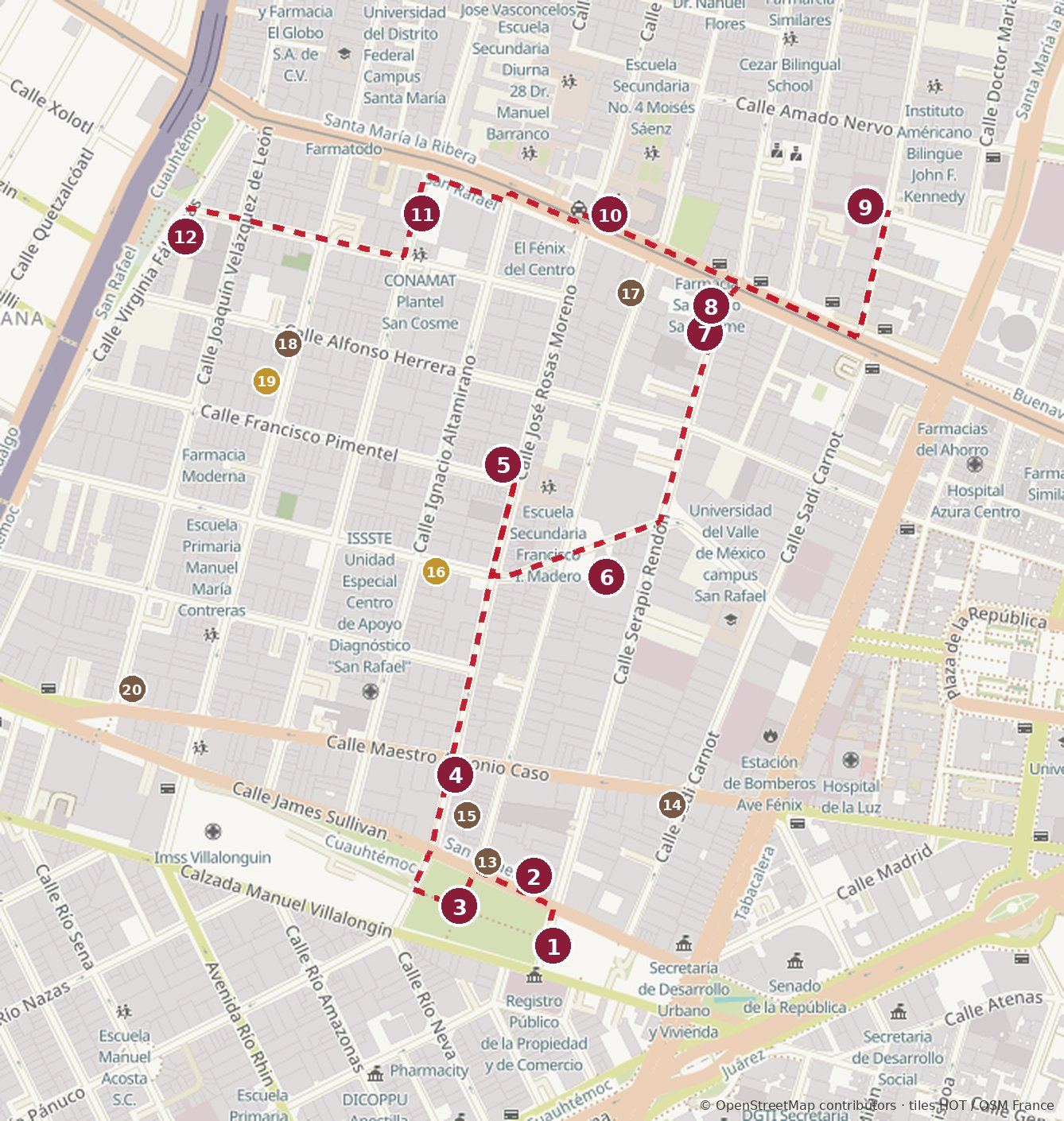
Coffee 13Quentin Café San Rafael · 14Café Gran Premio · 15Flow33 Café de Especialidad · 17Camino a Comala · 18Benigna · 20Overeal Café y Vintage
Bakeries 16Vendaval Cooperativa Panadera · 19220 Panadería
Click to enlarge. Map data © OpenStreetMap contributors.
| # | Stop | What it is |
|---|---|---|
| 1 | Monumento a la Madre | 1949 monument and plaza; start |
| 2 | Museo Experimental El Eco | Goeritz’s 1953 experimental museum |
| 3 | Jardín del Arte and the Sullivan market | Weekend market, Sunday art fair |
| 4 | Caso, Leonora Carrington’s first home | First Soviet embassy, then Carrington’s home |
| 5 | Galería Hilario Galguera | Gallery in an unsigned mansion |
| 6 | La Privada Roja | Red private street of about 1908 |
| 7 | Cine Ópera | Abandoned 1949 Art Deco cinema |
| 8 | Parroquia de San Cosme y San Damián | 17th-century parish church |
| 9 | Museo Universitario del Chopo | German iron-and-glass museum |
| 10 | Casa de los Mascarones | 1760s baroque country house |
| 11 | Gabino Barreda 17 and 18 | Remedios Varo’s building and a Moorish house |
| 12 | Teatro San Rafael and the theater district | 1977 theater; end |
The walk, part 1: Sullivan to the Galguera gallery
The first part stays on the south side. A monument, an experimental museum, the market, then north past the house where Carrington started her Mexican life to a gallery with no sign.
1. Monumento a la Madre

Sullivan at Manuel Villalongín · open space · free
Have the driver drop you on Sullivan. A monument to Mexico’s mothers, a group of three sculptures inaugurated on 10 May 1949, Mother’s Day in Mexico. The broad plaza fills on Sundays with dancers, dog walkers and band rehearsals. The city’s free Paseos Históricos tours of San Rafael start here.
Coffee before you start: Quentin Café at Miguel E. Schultz 146, a minute from El Eco (brown circle on the map), opens daily at 7:00. For something older, Café Gran Premio at Antonio Caso 72, about four minutes north-east (brown circle on the map, Mon–Sat 8:00–20:30), has been roasting Veracruz coffee since 1962. Buy a bag of beans to take home.
2. Museo Experimental El Eco

James Sullivan 43 · Tue–Sun 11:00–18:00 · free
A minute north, across Sullivan. Mathias Goeritz built El Eco in 1953 as an experiment in what he called emotional architecture. Within two years it had become a bar. UNAM bought it and restored it in 2004, and it now shows contemporary art. Exhibitions are small; the building is the show. Look for Goeritz’s yellow tower in the courtyard.
3. Jardín del Arte and the Sullivan market

Sullivan and Manuel Villalongín · park always open; market Sat–Sun 9:00–18:00; art fair Sundays · free
Two minutes west, behind the monument. Artists started showing work outdoors here in 1955, on the site of the old railway station, and the Sunday Jardín del Arte has run with few breaks ever since. The association now has about 500 painters, sculptors, printmakers and photographers. The art is better than you would expect and the painters will talk to you about it.
On weekends Sullivan also turns into a tianguis of food stalls, secondhand clothes, books and bric-a-brac. One tlacoyo seller has had the same spot for more than 30 years. If you skipped breakfast, eat a tlacoyo or a mixiote here.
4. Caso, Leonora Carrington’s first home
José Rosas Moreno 142 at Antonio Caso · event venue, exterior only · free
Three minutes north up Rosas Moreno, on the corner of Antonio Caso. This brick house, about a hundred years old, opened as the first Soviet embassy in Mexico. Time Out says the embassy ran until 1938 and drew artists and writers including Remedios Varo, Salvador Novo and Frida Kahlo. In the 1940s it became Leonora Carrington’s first home in the city, which she shared with Renato Leduc, her first husband. She later moved to Roma, where she lived until her death.
For years the house stood empty and burned; Wikipedia still describes the roof as largely collapsed. It has since been restored and is rented out for weddings and parties under the name Caso, so you see it from the street.
Coffee: Flow33, two doors down at Rosas Moreno 146 (brown circle on the map), is a specialty coffee bar inside a flower shop. Daily from 9:00 or 10:00.
Shop: Squash 73, three minutes west at Antonio Caso 147, is a showroom for Mexican design brands (Mon–Fri 9:00–18:00). On a weekend, skip it.
Bakery: on the way to the next stop, Vendaval, a cooperative bakery and café at Guillermo Prieto 46 (gold circle on the map), Mon–Sat 9:00–20:00, Sun 11:00–16:00.
5. Galería Hilario Galguera
Francisco Pimentel 3 · Tue–Fri 11:00–17:00, Sat 11:00–14:00 · free
About six minutes north, to Francisco Pimentel. A contemporary gallery in an old mansion with no sign on the door. Finding it is half the fun. Look for the number and ring. It represents more than a dozen international artists, and the staircase and the light are worth the visit even if the show isn’t.
The walk, part 2: La Privada Roja to the theaters
The second part is the old heart of the neighborhood. The red street, the ruined cinema and the colonial church, then across Ribera de San Cosme for the Chopo and the masks, and back west to the surrealists and the theaters.
6. La Privada Roja
Serapio Rendón 61 · daily (check hours) · free
About four minutes south-east, on Serapio Rendón. A private street of houses painted entirely red, built between 1898 and 1908. An Italian ambassador once lived here. It has been a residence, a cultural corridor and student lodging, and now holds cafés and small restaurants along its central passage. A host at the gate seats you, and you may be asked to leave ID. If you only want to look, say so.
7. Cine Ópera

Serapio Rendón 9 · exterior only · free
About five minutes north up Serapio Rendón. The ruin everyone photographs. Cine Ópera opened in 1949, at the height of Mexican cinema’s golden age, behind an Art Deco facade with two statues; set designer Manuel Fontanals did the interior. With almost 4,000 seats it was the biggest of the neighborhood’s cinemas. It premiered Una familia de tantas in 1949 and hosted a well-known Bauhaus concert in the 1990s. It closed in 1998. Bellas Artes bought it in 2011 to make a cultural center, but it still stands empty, its roof partly fallen in. Admire it from the sidewalk.
Lunch: La Chalupería, two minutes west at Miguel E. Schultz 29, serves Puebla-style antojitos from Zacatlán and Huauchinango. Thu–Fri 13:00–22:00, Sat 10:00–22:00, Sun 9:00–18:00, closed Mon–Wed. On those days, eat in the Privada Roja or hold out for the cantinas at the end.
8. Parroquia de San Cosme y San Damián

Serapio Rendón 5 at Ribera de San Cosme · Mon–Sat 9:00–19:30, Sun 8:30–19:30 · free
Next door. The neighborhood is older than it looks. This church was begun in 1672 on the site of a 16th-century chapel and hospital. Inside is a gilded Churrigueresque altarpiece brought from San Joaquín de Tacuba, and a viceroy, Juan Vázquez de Acuña, has been buried here since 1734. In the atrium, neighbors paid for bronze sculptures inspired by Remedios Varo and Leonora Carrington. Thieves later took three pieces, so what you find there depends on the year.
Coffee: Camino a Comala, a minute away at Miguel E. Schultz 7C (brown circle on the map), Tue–Sun 8:00–22:00, closed Mon. The best coffee on the walk. Beans from Colima, brewed by Chemex or dripper, and sourdough pastries.
9. Museo Universitario del Chopo
Dr. Enrique González Martínez 10, Santa María la Ribera · Wed–Sun 11:30–18:00 · 30 pesos (~1.60 USD), free on Wednesdays
About six minutes east. Cross Ribera de San Cosme at the lights and turn north on Enrique González Martínez. Strictly this is Santa María la Ribera, but you won’t notice the border. The iron and glass building was made in Düsseldorf in the early 20th century to a design by Bruno Möhring and shipped to Mexico by José Landero y Coss, who went bankrupt in 1905. A fire in 1964 left it empty for almost ten years, and UNAM opened it as a museum in 1975. It shows contemporary and alternative art and has a cinema, a bookshop and a café.
10. Casa de los Mascarones

Ribera de San Cosme 71 · exterior only · free
About eight minutes west along Ribera de San Cosme, on the north side. One of the last baroque country houses in the city, built 1766–1771 for the Count of the Orizaba Valley. The “masks” are the grotesque figures carved on the facade. The count never finished it; it was auctioned in 1822 and is now a UNAM language school, open to students and staff only. Pollution and the street vendors in front don’t help, but look up at the carved pilasters.
11. Gabino Barreda 17 and 18
Gabino Barreda 17 and 18 · private houses, exterior only · free
About five minutes west. Cross back over Ribera de San Cosme and turn south into Gabino Barreda. Remedios Varo and the French poet Benjamin Péret lived at number 18, in what Chilango calls a run-down apartment, and Leonora Carrington came over often. There is no plaque and nothing to visit. Across the street, number 17 is a Porfirian house in the eclectic style of the time, with Moorish touches. This is the kind of street San Rafael is made of.
Coffee or a pastry: on Manuel María Contreras, two minutes south of the route, Benigna at number 35A (brown circle on the map, check hours) is a café inside a shop of Mexican design goods and small-batch pantry products, and 220 Panadería at number 45 (gold circle on the map, Tue–Fri 8:00–21:00, Sat 9:00–21:00, Sun 9:00–18:00) bakes the best bread in the neighborhood. It’s takeaway only.
12. Teatro San Rafael and the theater district

Virginia Fábregas 40 · box office daily from 12:00 · tickets vary
About six minutes west, past the corner of Manuel María Contreras. The heart of what was once Mexico’s Broadway. The actor Manolo Fábregas, “Señor Teatro,” opened it in 1977 with the best equipment of its day. The Centro Teatral Manolo Fábregas is around the corner on Velázquez de León, and the Teatro Jorge Negrete dates from 1957. Not every house survived; the Aldama on Rosas Moreno closed in 1999. About ten mid-century theaters still put on shows. Check what’s on and come back for an evening performance.
The walk ends here. Get an Uber home, or end the way San Rafael has always ended its days, in a cantina.
Drinks: La Numantina, back at Manuel María Contreras 4, is one of the oldest cantinas in the colonia and still serves free food with your drinks, usually to live music (Mon–Tue 13:00–21:00, Wed 13:00–22:00, Thu 13:00–23:00, Fri–Sat 13:00–1:00, closed Sun). For dinner, Vacaciones at number 35 serves Mediterranean food and spritzes in a room open to the street, with a menu that changes weekly (Tue–Thu 17:00–24:00, Fri–Sat 14:00–24:00, Sun 14:00–19:00). The focaccia never leaves it.
Late lunch: La Polar, about six minutes south at Guillermo Prieto 129 (daily 8:00–1:00), is the classic San Rafael birria house, open since 1934, loud and old-school, with roving musicians and beer only. Order your cut by name or you’ll get a mix. Or try Las Barricas at Manuel María Contreras 68, a proper cantina where each round of drinks brings another course of botanas, for about 200 pesos (~10 USD) a head. Arrive around 14:00, before the tables and the best dishes run out.
Coffee, food and drink
For coffee, go to Camino a Comala; for lunch, La Chalupería or La Polar; for the evening, Vacaciones then La Numantina.
| Place | What | Where |
|---|---|---|
| Quentin Café | Coffee, pastries, opens 7:00 | Miguel E. Schultz 146, by stop 2 |
| Café Gran Premio | Old-school café, beans to take away | Antonio Caso 72, near stop 1 |
| Flow33 | Specialty coffee in a flower shop | Rosas Moreno 146, at stop 4 |
| Vendaval | Cooperative bakery and café | Guillermo Prieto 46, between stops 4 and 5 |
| Camino a Comala | Specialty coffee, sourdough | Miguel E. Schultz 7C, by stop 8 |
| La Chalupería | Puebla-style antojitos | Miguel E. Schultz 29, by stop 7 |
| Benigna | Coffee, brunch, natural wine | Manuel María Contreras 35A, near stop 11 |
| 220 Panadería | Bread and pastries to take away | Manuel María Contreras 45, near stop 11 |
| Vacaciones | Mediterranean, wine, spritz | Manuel María Contreras 35, near stop 12 |
| La Numantina | Cantina, free food, live music | Manuel María Contreras 4, between stops 11 and 12 |
| Las Barricas | Cantina, free botanas | Manuel María Contreras 68, near stop 12 |
| La Polar | Birria, since 1934 | Guillermo Prieto 129, near stop 12 |
| Cantina La Castellana | Cantina, a grocery store in 1892 | Antonio Caso 58 at Insurgentes, near stop 1 |
| La Especial de París | Ice cream since 1921 | Insurgentes Centro 117-B, near stop 1 |
| Overeal Café y Vintage | Coffee, cake, vintage clothes | Velázquez de León 126, south of stop 12 |
If you just want a familiar cup, the chains are on the edges of the route:
- Tierra Garat on Sullivan, right by the start
- Starbucks at Héroes Ferrocarrileros 46, Santa María la Ribera, a few minutes east of the Chopo (stop 9)
- Starbucks at Paseo de la Reforma 195 and Cielito Querido at Reforma 243, south of the start across Reforma
Shops worth the detour
San Rafael has no shopping street; its best shops hide inside cafés and on the weekend median of Sullivan.
- Sullivan market and Jardín del Arte (stop 3): weekend stalls of books, secondhand clothes and antiques; Sunday paintings straight from the painters.
- Benigna, Manuel María Contreras 35A: Mexican design goods, mugs, tote bags, small-producer wine, salsas and jams.
- Overeal, Velázquez de León 126: vintage clothing racks behind the café, about eight minutes south of stop 12.
- Squash 73, Antonio Caso 147: a showroom for Mexican design brands. Weekdays only.
- Galleries on Manuel María Contreras: Time Out recommends walking the street for its contemporary galleries.
- Camino a Comala and Café Gran Premio: bags of Mexican coffee, the best souvenir on the route.
Which day to walk
Saturday gets you the most; Monday the least. Only the places with limited days or hours are listed below.
| Place | Mon | Tue–Fri | Sat | Sun |
|---|---|---|---|---|
| 2 El Eco | Closed | Open | Open | Open |
| 3 Sullivan market | Park only | Park only | Market | Market and Jardín del Arte |
| 5 Galería Hilario Galguera | Closed | 11:00–17:00 | 11:00–14:00 | Closed |
| 9 Museo del Chopo | Closed | Wed–Fri only | Open | Open |
| Camino a Comala | Closed | Open | Open | Open |
| La Chalupería (lunch) | Closed | Thu–Fri from 13:00 | Open | To 18:00 |
| Vacaciones | Closed | From 17:00 (Fri 14:00) | From 14:00 | 14:00–19:00 |
| La Numantina | Open | Open | Open | Closed |
| Squash 73 | Open | Open | Closed | Closed |
On a Saturday, start around 10:45 so El Eco is just opening and the Galguera gallery falls well before 14:00. On a Sunday, skip stop 5 and finish at Las Barricas or La Polar instead of La Numantina.
Keep walking
San Rafael borders three other walks in this series, so you can carry straight on.
- North: Santa María la Ribera. From the Chopo (stop 9) you are already in it. Within ten minutes you reach the Kiosco Morisco and the UNAM geology museum, with its mammoth skulls and 1906 building. Santa María la Ribera on Foot covers it.
- South: Juárez and Reforma. From the start, cross Paseo de la Reforma into Juárez. Reforma on Foot covers the avenue.
- East: the Monumento a la Revolución. About ten minutes east of stop 1 along Antonio Caso, with the Frontón México on the same plaza, and the gateway to the Centro guides.
About the author and where to stay
Brian has lived in Roma Norte for about five years and writes the See Mexico City guides. He speaks seven languages and still gets lost on purpose.
When you visit, stay with us at Penthouse El Cielo de Roma in Roma Norte.
Photo credits
Photos via Wikimedia Commons, used under the licenses shown. Numbers match the captions.
- Monumento a la Madre.JPG, Laura Velázquez, CC BY-SA 3.0
- Pabellón Eco by Frida Escobedo (2010).jpg, Jorge Munguía, CC BY-SA 4.0
- Jardin del Arte Sullivan.JPG, Agustin Valero, CC BY-SA 3.0
- The gloriously abandoned Cine Opera.jpg, Matthew Rutledge, CC BY 2.0
- Parroquia de los santos Cosme y Damián de noche.jpg, Juan Carlos Fonseca Mata, CC BY-SA 4.0
- Casa de los Mascarones 2019 – 1.jpg, ProtoplasmaKid, CC BY-SA 4.0
- ManoloFabregasTheaterDF.JPG, Thelmadatter, CC BY-SA 3.0
Map: drawn from OpenStreetMap data, © OpenStreetMap contributors, Open Database License.
Sources
Hours and prices checked October 2026; confirm before you go.
- Chilango: 12 horas en la colonia San Rafael
- Chilango: Ruta de lugares chidos de la colonia San Rafael
- Chilango: Recorriendo la San Rafael (2012)
- Chilango: 10 lugares de Leonora Carrington en el DF
- México Desconocido: 9 lugares para disfrutar la colonia San Rafael
- Time Out México: San Rafael, barrio cool 2024
- Time Out México: Edificios emblemáticos de la San Rafael
- Time Out México: Restaurantes en la San Rafael
- Time Out México: Las Barricas
- Time Out México: Vacaciones
- La Jornada: La San Rafael
- Food & Pleasure: La primera casa de Leonora Carrington en CDMX
- Food & Pleasure: Benigna
- Food & Pleasure: Dónde comer en la colonia San Rafael
- El Universal: Qué hacer y ver en la Privada Roja
- CDMX Secreta: Qué hacer en la colonia San Rafael
- CDMX Secreta: Recorridos gratuitos por la San Rafael y la Romita
- TV Azteca: Las esculturas de Remedios Varo y Leonora Carrington en la parroquia de San Cosme
- Posta: Museo del Chopo, precios y qué ver (August 2025)
- Atlas Obscura: Cine Ópera
- Mexico City tourism: Jardín del Arte
- Mexico City tourism: Casa de los Mascarones
- Mexico City tourism: Temple of Saints Cosme and Damián
- Wikipedia: Colonia San Rafael
- Wikipedia: Jardín del Arte Sullivan
- Fodor’s: San Rafael and Santa María la Ribera sights
- Hours and coordinates for stops, cafés, restaurants and cantinas: Google Maps place listings, October 2026