Northwest: Tacuba on Foot
Why Tacuba
Tacuba is where the Aztec world ended for Hernán Cortés, at least for one night. It was Tlacopan, the third and smallest partner of the Triple Alliance, and the causeway that tied it to Tenochtitlan is still the main road. Along it you get a 16th-century Franciscan church, a 17th-century chapel, the old Colegio Militar, the stump of the tree Cortés supposedly cried under, a century-old cantina and a market that spills out into the street.
It sits in the north-west of the city, in Miguel Hidalgo borough, about 5 km from the Zócalo. The walk follows the Calzada México-Tacuba west from the Escuela Nacional de Maestros, through the old village of Popotla, to the church and market at Metro Tacuba. The ground is flat.
This walk suits people who like history more than polish. Tacuba is not pretty in the Coyoacán sense. The calzada is loud, the Metro Tacuba end is a scrum of street stalls and buses, and some of the most famous sites are a chapel that is usually locked and a tree that is mostly dead. I still think it is one of the most interesting walks in the city, because almost everything on it is older than it looks.
Practical basics
The walk is about 3.6 km, one way, and takes half a day with stops. Take an Uber or taxi to the start and home from the end. Do it on a Thursday or Friday, when everything on the route is open.
| Start | Benemérita Escuela Nacional de Maestros, Calz. México-Tacuba 75 |
| Finish | Mercado de Tacuba, Calz. México-Tacuba 743, behind the church of San Gabriel |
| Distance | About 3.6 km; roughly 50 minutes of pure walking |
| Time needed | 3–4 hours with the museum, coffee and a pulque |
| Best day | Thursday or Friday: the school is open to ask at the gate, the museum, the pulquería and the parish are all open |
| Avoid | Monday (Museo de Caballería closed), Tuesday (Verde Mata closed) and weekends if you want to see the Orozco mural |
| Toilets | Buy something: Café Popotla, Verde Mata and Chin Chun Chan; paid toilets in the market |
If you come by public transport, Metro Normal (Line 2) is right by the start, and Metro Tacuba (Lines 2 and 7) is at the finish. Metro Colegio Militar, Popotla and Cuitláhuac are all on the way, so you can join or leave at any point.
Start around 10:30. You reach the museum after it opens, Café Popotla before it closes at 14:00 and Verde Mata around 13:00, when it opens. If you are short of time, skip the start and begin at the Museo de Caballería; that cuts about a kilometer.
Tacuba is a working neighborhood with a rough reputation, and the borough has run a special police operation on the calzada since January 2025. Walk it in daylight only. Keep your phone in a front pocket around Metro Tacuba, the market and the street stalls, where pickpocketing is the common crime. Parque Cañitas is fine by day and not a place to be after dark. Don’t wander north of the Metro Tacuba area toward the warehouses.
A short history
Tlacopan means “place of the jarilla plant”. It was a Tepanec town under Azcapotzalco until Itzcóatl of Tenochtitlan defeated the Tepanecs between 1428 and 1430. Tlacopan did not fight and became the third member of the Triple Alliance, with Tenochtitlan and Texcoco. A causeway linked it to the island city. It is today’s Calzada México-Tacuba, which INAH describes as a busy road for more than 500 years.
On the night of 30 June 1520 Cortés and his men fled Tenochtitlan along this causeway, carrying gold melted into bars, and lost a large part of their army. Legend says Cortés sat under an ahuehuete in Popotla and wept. After the conquest he tortured Tetlepanquetzal, the last ruler of Tlacopan, on suspicion of hiding treasure. In 1526 a royal decree gave Tacuba to Isabel Moctezuma, daughter of Moctezuma II, as an encomienda of 120 households.
The Franciscans built San Gabriel Arcángel over the old ceremonial center; it was largely finished around 1584 and was the mother church for about 18 villages. By 1632 the area had 60 haciendas. Popotla stayed farmland, with orchards around the Merced de las Huertas monastery (its chapel was finished in 1680), until the Porfiriato brought villas along Mar Mediterráneo and Mar Egeo. The streets are named after seas, gulfs and lakes, so you will walk Mar Blanco, Mar Tirreno and Golfo de Adén.
In 1910 a new teachers’ college opened in Popotla. After the Revolution the building became the Colegio Militar, which stayed until 1976. In 1928 Tacuba lost its status as a municipality. The old market was replaced in 1956, and Metro Tacuba opened in 1970 as the end of Line 2. The 1984 extension and the elevated Marina Nacional nearly wiped out the church’s atrium and garden.
Since the 1950s Tacuba has had a name for crime, traffic and street vending. In 2011 the city made it a Barrio Mágico. In 2021, for the 500th anniversary, the tree and its plaza were officially renamed the Noche Victoriosa, to honor the people who drove the Spanish out that night.
The route
The walk runs one way, east to west, from the Escuela Nacional de Maestros along the Calzada México-Tacuba to the church and market at Metro Tacuba, in 9 numbered stops. Follow it on the Tacuba on Foot map, which shows every stop, the walking route, the cafés and bakeries along the way and the nearest chain cafés.
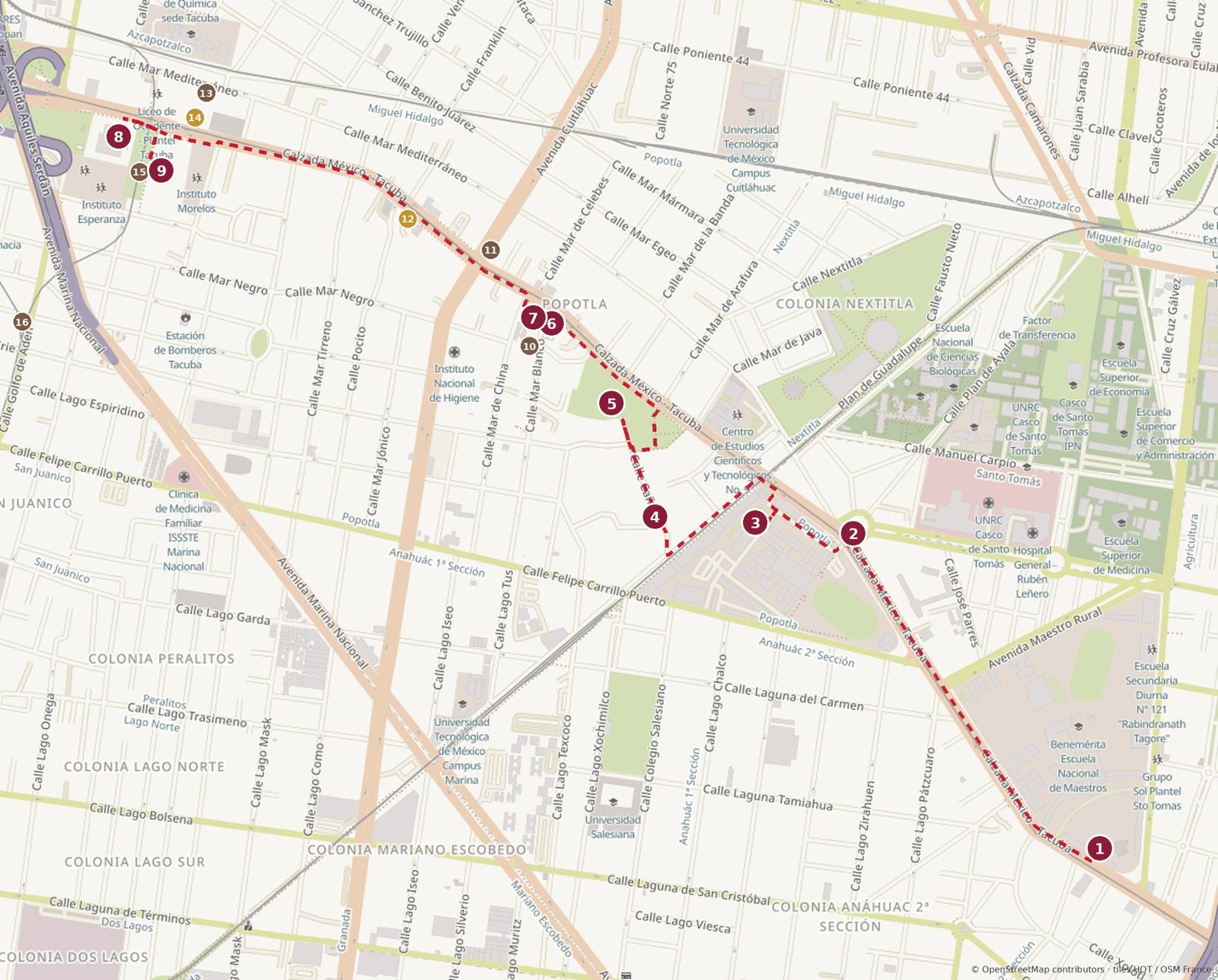
Coffee 10Café Popotla · 11Sr. Cacao · 13Los Chaneques Coffee Shop · 15RutaCafé · 16Lorenza's Coffee
Bakeries 12Panadería Claudia · 14Pastelería La Palanca
Click to enlarge. Map data © OpenStreetMap contributors.
| # | Stop | What it is |
|---|---|---|
| 1 | Benemérita Escuela Nacional de Maestros | Pani’s teachers’ college, Orozco mural |
| 2 | Capilla de la Merced de las Huertas | 17th-century chapel |
| 3 | Antiguo Colegio Militar and Museo de Caballería | Old military college, cavalry museum |
| 4 | Casa Cañitas | The haunted-house legend |
| 5 | Parque Cañitas | Neighborhood park |
| 6 | Parroquia del Pronto Socorro | Popotla’s parish church and mural |
| 7 | Árbol de la Noche Victoriosa | Cortés’s tree, renamed |
| 8 | Parroquia de San Gabriel Arcángel | Franciscan church, 1580s |
| 9 | Mercado de Tacuba | 1956 market behind the church |
The walk, part 1: the Normal to Popotla
The first half follows the calzada past two big institutions and a colonial chapel, then turns into Popotla for a haunted house and a park.
1. Benemérita Escuela Nacional de Maestros

Calz. México-Tacuba 75 · Mon–Fri 7:30–18:00 · free
Mexico’s national teachers’ college. Mario Pani designed the complex, begun in 1945, and Luis Ortiz Monasterio carved the long sculpted facade. Pani’s 71-meter tower leaned after the 1957 earthquake and was taken down in 1972; it survives as the logo of Metro Normal. In 1947, at Pani’s invitation, José Clemente Orozco painted his first outdoor mural here, the Alegoría Nacional, on the curved wall of the open-air theater.
It is a working school, not a museum. Time Out’s advice still holds: ask the guard politely if you can see the mural. Weekdays only.
Coffee before you start: there is no independent café at this end, but Pastelería Esperanza is at Calz. México-Tacuba 11, just east of the school.
2. Capilla de la Merced de las Huertas

Calz. México-Tacuba 305 · usually open only around weekend Mass (Sat–Sun 7:30–8:00 and 17:15–18:30) · free
Walk about 11 minutes west along the calzada. This small chapel, finished in 1680 with a Baroque side portal added in 1737, is all that is left of the Merced monastery and its orchards, the huertas. Inside is a 1762 wooden Virgin of Mercy, known as the Virgin of Tacuba. It was stolen in 2005 and only returned, restored, in 2012. On a weekday you will probably see it from the outside only, which is fine; the portal is the point.
3. Antiguo Colegio Militar and Museo de Caballería

Campo Militar 1-B, Calz. México-Tacuba · Tue–Sat 10:00–18:00, Sun 10:00–16:00 · free
Across the road is the big French-style building that opened in 1910 as the teachers’ college and served as the Colegio Militar from the 1920s until 1976, when the academy moved to Tlalpan. It now houses the army’s university. The cavalry museum inside opened in 2006: six small galleries from the conquest to today, with saddles, swords, battle models and portraits of Villa, Zapata and a surprisingly young Porfirio Díaz. You register at the gate and leave an ID. Allow 40 minutes.
4. Casa Cañitas
Cañitas 51 · exterior only · free
Walk about seven minutes west into Popotla. This ordinary-looking house became famous in the 1990s through a book that claims to tell true stories of a séance gone wrong and the hauntings that followed. Neighbors are tired of it, and Google reviewers mostly report litter. Look, take your photo, move on. People live on this street.
5. Parque Cañitas
Cañitas at Calz. México-Tacuba · open 24 hours, daylight only · free
Three minutes north is Popotla’s park, with tall trees, benches, basketball courts and a lot of dogs. There are cultural events on weekends, especially Sundays. In January 2025 the borough mayor chose it to launch the operation to make the calzada safer, which tells you something about both.
The walk, part 2: the tree to Tacuba
The second half is the Noche Triste site, coffee and lunch in Popotla, and the old center of Tlacopan around Metro Tacuba.
6. Parroquia del Pronto Socorro

Calz. México-Tacuba 490 · closed Wed; other days roughly 7:30–14:00 and 16:00–20:00 · free
Walk about seven minutes north-west, back to the calzada. This is the parish church of the old village of San Esteban Popotla. A hermitage stood here in the 16th century; the present church dates from the mid-20th century and is dedicated to Our Lady of Prompt Succor, a devotion that began in New Orleans. In May 2010 artists painted the mural Noche de la Victoria on its outer wall, telling the story of 1520 from the Mexica side.
7. Árbol de la Noche Victoriosa

Calz. México-Tacuba 453 · open space · free
Next door, behind a railing, is the trunk of the ahuehuete where Cortés is said to have wept on 30 June 1520. It was badly burned on 2 May 1872 and has been dying slowly ever since; a weeping willow grows beside it. Not everyone agrees it is even the right tree; some say the real one stood in Naucalpan. In 2021 the city renamed it the Tree of the Victorious Night, and the plaza with it. An ingot of the gold Cortés lost that night was found in 1981 and is in the Museo Nacional de Antropología.
Coffee break: Café Popotla (Mar Blanco 118), a minute from the tree (brown circle on the map). It is a small roaster with a few tables: good cappuccino, breakfasts, and several blends you can buy whole or ground. Mon–Sat 9:00–14:00 (Wed from 10:00), closed Sun, so don’t leave it for later. On a Sunday, go to Sr. Cacao (Av. Cuitláhuac 3C), about three minutes north, for coffee, horchata cacao and chilaquiles.
Lunch: Verde Mata (Mar Tirreno 109) is a short detour on the way west through Popotla’s side streets, and adds about three minutes. It is a pulquería for people who think they don’t like pulque: fresh natural pulque, curados such as strawberry and basil, a beer-and-mezcal deal if you won’t try it, and a short menu of home cooking that changes daily. The owners like to talk. Have one, not three; there is more walking. Wed–Thu 13:00–21:00, Fri–Sat 13:00–23:00, Sun 13:00–22:00, closed Mon–Tue. On a Monday or Tuesday, have the comida corrida at Restaurante Los Ingenieros (Calz. México-Tacuba 585, Mon–Fri), on the calzada a few minutes west of the tree.
8. Parroquia de San Gabriel Arcángel

Calz. México-Tacuba at Aquiles Serdán · Mon–Fri 10:00–14:00 and 16:00–19:00, Sat 10:00–14:00, Sun 8:00–19:00 · free
Walk about 14 minutes west along the calzada to the church of Tlacopan. The Franciscans built it over the pre-Hispanic ceremonial site and had it largely finished around 1584; it was altered in 1755, 1871 and the 1970s. Outside is a stone atrium and a Baroque facade, with a side portal facing the calzada. Inside, a gilded main altar with Salomonic columns, and part of the old cloister.
The quirky thing is the Santo Niño de los Milagros, a Christ Child brought from Xochimilco in 1970. During World Cups, and only then, he is dressed in the Mexican team’s kit, and fans come to ask for goals. The rest of the time he wears the baby clothes people leave in thanks. Time Out called the church an oasis, and once you are past the stalls it is.
Coffee: Los Chaneques (Mar Mediterráneo 45), about four minutes north-east, sells Mexican coffee by region, with beans ground to order (brown circle on the map). Pastelería La Palanca (Calz. México-Tacuba 735), about three minutes away, has pan dulce (gold circle on the map).
9. Mercado de Tacuba

Calz. México-Tacuba 743 · daily from morning; check hours · free
Behind the church, two minutes away, is the market that replaced the old stone one in 1956. It is the biggest of Miguel Hidalgo’s 18 public markets, with about 1,200 vendors counted in a 2017 study, and its stalls run out along the calzada as a permanent tianguis. If you skipped lunch, find a counter where people are queuing. Keep your bag in front of you. Metro Tacuba is right here.
A drink to finish: Chin Chun Chan (Golfo de Adén at Lago Hurón), about seven minutes south-west of the church, daily 12:00–24:00, about 150 pesos (~8 USD) a head. Time Out put it at a hundred-and-something years old. It is a neighborhood place, plain from the outside, with walls of Marilyn Monroe portraits, tortas of pork leg, botanas if you come early and live music some evenings. Sunday afternoons are the liveliest. Lorenza’s Coffee (Golfo de Adén 27) is around the corner if you want coffee instead (brown circle on the map).
Coffee, food and drink
For coffee, go to Café Popotla; for lunch, Verde Mata, a comida corrida or the Mercado de Tacuba; for a drink, Verde Mata then Chin Chun Chan.
| Place | What | Where |
|---|---|---|
| Café Popotla | Coffee, breakfast, beans to take away | Mar Blanco 118, by stop 7 |
| Sr. Cacao | Coffee, horchata cacao, chilaquiles | Av. Cuitláhuac 3C, near stop 7 |
| Lorenza’s Coffee | Breakfasts, chilaquiles (closed Sun) | Golfo de Adén 27, by Chin Chun Chan |
| Los Chaneques | Mexican coffee by region, beans ground to order | Mar Mediterráneo 45, near stop 8 |
| Pastelería La Palanca | Bakery | Calz. México-Tacuba 735, by stop 9 |
| Restaurante Los Ingenieros | Comida corrida (Mon–Fri) | Calz. México-Tacuba 585, between stops 7 and 8 |
| Comida Corrida Doña Edith | Home cooking, pozole on Fridays | Reyna Xóchitl 10, near stop 5 |
| 3 con Todo | Tacos al pastor, from 13:00 | Av. Cuitláhuac 2398, north of stop 7 |
| Verde Mata | Pulque and daily home cooking | Mar Tirreno 109, between stops 7 and 8 |
| Mercado de Tacuba | Lunch counters | Stop 9 |
| Cantina La Colorada | Neighborhood cantina, botanas | Mar Arábigo 1, near stop 9 |
| Chin Chun Chan | Cantina, tortas | Golfo de Adén at Lago Hurón, south-west of stop 8 |
If you just want a familiar cup, the chains sit at the edges of the route:
- Pastelería Esperanza at Calz. México-Tacuba 11, just east of the start
- Cielito Querido at Av. Marina Nacional 60, south of stop 8
- Starbucks at Egipto 142, Clavería, north of Popotla
Shops worth the detour
Tacuba has no shopping street; it has a market and a few good coffee counters.
- Mercado de Tacuba (stop 9) and the tianguis along the calzada: fresh food, clothes and household goods.
- Los Chaneques (Mar Mediterráneo 45): beans from different Mexican regions, explained and ground to order. The best souvenir on the route.
- Café Popotla (Mar Blanco 118, by stop 7): its own blends, whole or ground.
- Pastelería La Palanca (Calz. México-Tacuba 735): pan dulce for the ride home.
Which day to walk
Thursday or Friday gets you the most; Monday the least. Only the stops and places with limited days are listed below.
| Stop | Mon | Tue–Fri | Sat | Sun |
|---|---|---|---|---|
| 1 Escuela Nacional de Maestros | Open | Open | Closed | Closed |
| 2 Merced de las Huertas | Exterior | Exterior | Mass times | Mass times |
| 3 Museo de Caballería | Closed | Open | Open | Until 16:00 |
| 6 Pronto Socorro | Open | Closed Wed | Open | Open |
| 8 San Gabriel Arcángel | Open | Open | Until 14:00 | Open |
| Café Popotla | Until 14:00 | Until 14:00 | Until 14:00 | Closed |
| Verde Mata | Closed | From 13:00, closed Tue | From 13:00 | From 13:00 |
On a weekend, skip the school, start at the museum and get your coffee at Sr. Cacao; on Sunday afternoons Chin Chun Chan is at its best.
Keep walking
Tacuba borders three other old neighborhoods, so you can carry on.
- North: Azcapotzalco. The Tepanec capital that once ruled Tlacopan is a short ride north from Metro Tacuba, with its own plaza and colonial church.
- South: Santa Julia. The colonia around the Parque Salesiano, about five minutes from the Museo de Caballería.
- East: Santa María la Ribera and San Rafael. From the start, follow the calzada east past Metro Normal to Ribera de San Cosme. San Rafael on Foot covers it.
About the author and where to stay
Brian has lived in Roma Norte for about five years and writes the See Mexico City guides. He speaks seven languages and still gets lost on purpose.
When you visit, stay with us at Penthouse El Cielo de Roma in Roma Norte.
Photo credits
Photos via Wikimedia Commons, used under the licenses shown. Numbers match the captions.
- Teatro Al Aire Libre y Mural en BENM, Benemérita Escuela Normal de Maestros, CDMX.jpg, ArUgalde, CC BY-SA 4.0
- Templo Merced de Las Huertas 2013-09-08 14-25-36.jpg, ProtoplasmaKid, CC BY-SA 3.0
- Colegio Militar de Popotla.JPG, Patricia Alzuarte Díaz, CC BY-SA 3.0
- Parroquia popotla.jpg, YoelResidente, CC0
- Árbol de la Noche Triste en Popotla.jpg, Mario Yaír TS, CC BY-SA 4.0
- FacadeTacubaChurch.JPG, AlejandroLinaresGarcia, CC BY-SA 4.0
- Mercado Tacuba.jpg, Flores95, CC BY-SA 4.0
Map: drawn from OpenStreetMap data, © OpenStreetMap contributors, Open Database License.
Sources
Hours and prices checked October 2026; confirm before you go.
- Wikipedia: Tacuba, Mexico City
- México Desconocido: Tacuba, La Escuela Normal de Maestros, una obra de Mario Pani y de José Clemente Orozco
- Mexico City tourism: Tree of the Victorious Night, San Gabriel Arcángel, Mercado Tacuba, Metro Tacuba, Cavalry Museum, Merced de las Huertas Chapel, Pronto Socorro Church
- Chilango: Ruta por Barrios Mágicos en CDMX, Santo Niño de los Milagros, Murales de Orozco en la CDMX
- Time Out México: Parroquia de San Gabriel Arcángel, Benemérita Escuela Nacional de Maestros, Chin Chun Chan
- Local.mx: Los edificios de Mario Pani en la Normal de Maestros
- INAH: Boletín 67, 2024 (recorridos La Noche Triste y Popotla)
- La Razón: Operativo Blindar México-Tacuba, January 2025