Far South: San Pedro Atocpan on Foot
Why San Pedro Atocpan
San Pedro Atocpan is the village that makes Mexico City’s mole. Around nine in ten people here live from it, and the town turns out something like 28,000 to 30,000 tons a year. Shop after shop on the main street sells it by the kilo, in paste and in powder, alongside dried chiles, sesame, peanuts and corn husks. In October it hosts the Feria Nacional del Mole, but the shops, the fondas and the colonial churches are there all year.
It is far. Atocpan sits in Milpa Alta, the rural borough at the southern edge of the city, on the hillside off the Xochimilco–Oaxtepec highway, about 27 km from Roma Norte as the crow flies. Allow an hour or more each way by car. The town is built on a slope between two volcanoes, Teutli and Cuauhtzin, so the streets go up and down, and up here the mornings are fresh and the afternoons turn cold. Bring a layer.
This walk suits people who like to eat, people who cook, and anyone who wants to see a working village inside the city limits. It is short, and it is mostly about food. Outside the main street and the two plazas, the town is plain houses and workshops, and on weekdays half the restaurants are closed. Come hungry, on a weekend, with an empty bag.
Practical basics
The walk is about 3.1 km, one way, plus 1.2 km more in October to reach the fair. It takes a long morning and lunch. Take an Uber or taxi up to the sanctuary and home from La Joya or the fairgrounds. Do it on a Saturday.
| Start | Santuario del Señor de las Misericordias, on the hill east of the center |
| Finish | Glorieta Tula, by La Joya restaurant; in October, the Feria Nacional del Mole grounds on the highway |
| Distance | About 3.1 km, roughly 42 minutes of pure walking; 4.3 km and 58 minutes with the fair |
| Time needed | 3–4 hours with shopping and a long lunch |
| Best day | Saturday: the weekend-only fondas are open and so are the mole shops that close on Sunday |
| Avoid | Monday to Thursday, when Teutli, La Ruta del Sabor and several other places are closed; Monday is worst |
| Toilets | The sanctuary has clean ones; otherwise buy something at El Familiar or Don Pancho |
There is no rail station anywhere near. The official route is Metro Taxqueña (Line 2), then bus route 81 or an RTP bus towards Milpa Alta from the north side of the station; ask to be let off at San Pedro Atocpan, or at the Feria del Mole in October. It takes well over an hour. The same buses run back from the highway.
If you are short of time, skip the sanctuary and start at the Plaza San Martín (stop 2). That saves the climb and more than a kilometer.
Atocpan is a quiet village and feels safe in daylight. There are a lot of stray dogs around the plazas; they are mostly sleepy. The walk from La Joya down to the fair runs beside a road with traffic, so keep to the edge. Carry cash: the small fondas take nothing else.
A short history
People have lived on this hillside since the 2nd century. Atocpan is one of the twelve original pueblos of Milpa Alta, and its Nahuatl name is usually given as “on fertile land”. Before the Spanish arrived it answered to Xochimilco, and farming, not mole, kept it going for most of its history.
The Franciscans came early in the colonial period and are thought to have begun the parish church around 1570. San Pedro Apóstol was dedicated on 28 August 1680 and declared a national monument in 1933. In 1864 Atocpan became a municipality and stayed one until after the Revolution; the agrarian reforms of the 1920s gave its families land.
Mole was festival food. Seventy-odd years ago only four mayordomos made it, one for each barrio, Panchimalco, Ocotitla, Nuztla and Tula, to feed the village on saints’ days. In the 1940s one family carried two kilos of hand-ground mole to the Merced market in the city and sold it all. In 1947 the road was paved and electricity arrived, and the rest of the town followed. By the mid-1970s Atocpan was making 8 to 10 tons a day. Its own invention is mole almendrado, with 26 to 28 ingredients on a base of mulato, pasilla and ancho chiles, and every family guards its recipe.
The Feria Nacional del Mole began in 1977 with four restaurants in the barrio of Yenhuitlalpan, around the Plaza San Martín, in May. Residents objected to a commercial fair during the May fiesta of the Señor de las Misericordias, so it moved to October and to the highway. In 2026 it held its 49th edition, from 3 to 25 October, with 23 restaurants and 17 mole producers. In 2011 the city named the village one of its Barrios Mágicos; the official list spells it “San Pedro Actopan”, and you will see that spelling too.
Mole is not the whole story of Milpa Alta. The borough is the city’s countryside, close to 60 percent of its rural land, and it grows around 300,000 tons of nopal a year, most of it sold at the collection market in Villa Milpa Alta. The maguey fields on the slopes still give pulque, which you will find sold by the liter at weekend fondas and, in October, all over the fair.
The route
The walk runs one way, from the hilltop sanctuary down into the center, along the main street to the two plazas and the market, up to the old chapel on the cemetery hill, and out to the Glorieta Tula and, in October, the fair, in 8 numbered stops. The mole shops and fondas line the way between them. Follow it on the San Pedro Atocpan on Foot map, which shows every stop and the cafés and bakeries nearby.
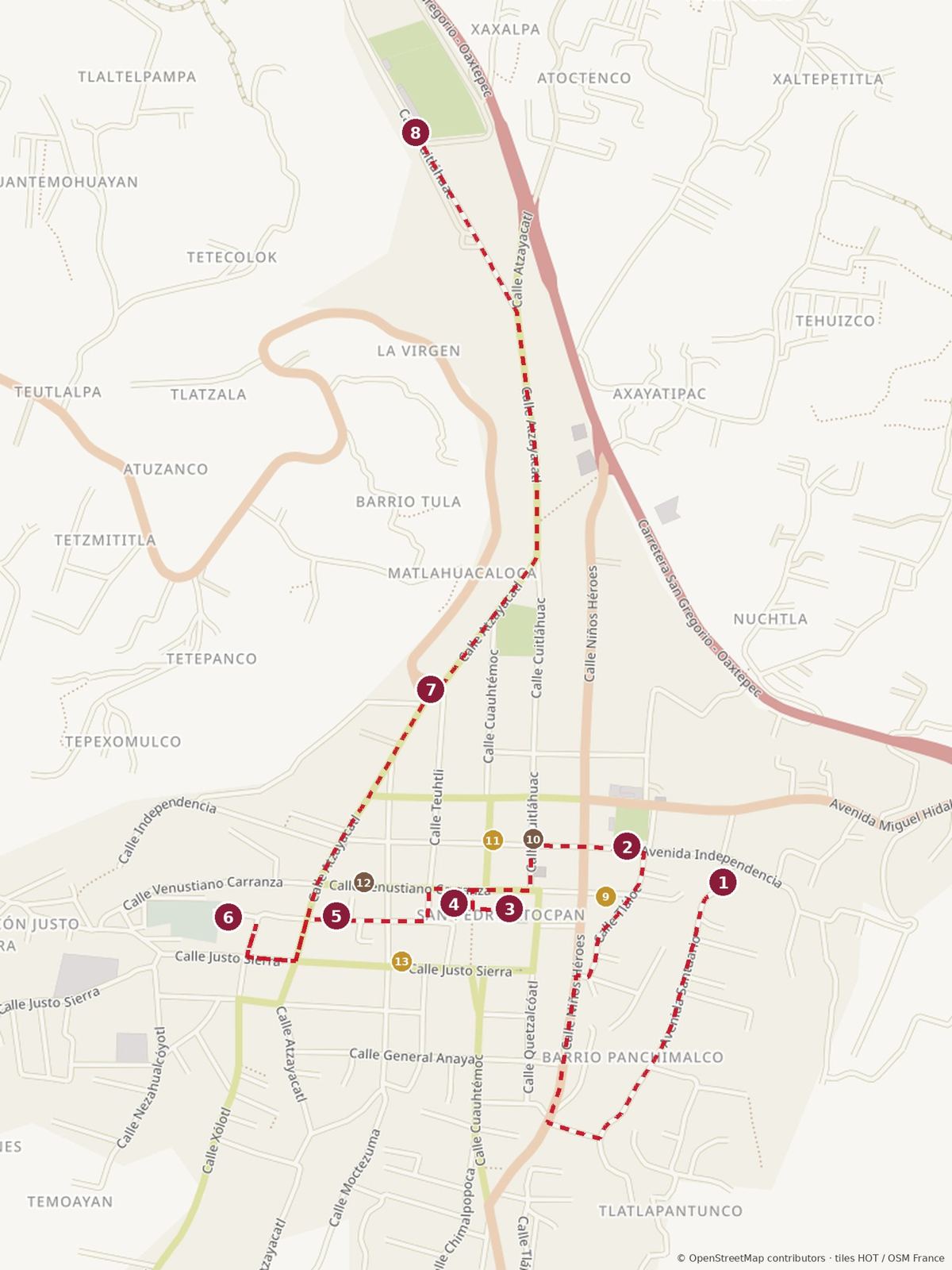
Coffee 10Café El Ermitaño · 12D Cuba Café
Bakeries 9Panadería Ameyalli · 11Aroma de Campo Repostería Artesanal · 13Pastelería y Gourmet Abeli
Click to enlarge. Map data © OpenStreetMap contributors.
| # | Stop | What it is |
|---|---|---|
| 1 | Santuario del Señor de las Misericordias | Hilltop sanctuary, views |
| 2 | Plaza and Capilla de San Martín | Sunken plaza, 1560 chapel |
| 3 | Parroquia de San Pedro Apóstol | Franciscan parish, 1680 |
| 4 | Mercado San Pedro and the plaza | Market and main square |
| 5 | Ex Hacienda Tlaixco | Old hacienda, now a restaurant |
| 6 | Capilla de la Guadalupita | 16th-century hilltop chapel |
| 7 | Glorieta Tula | Roundabout at the Tula barrio |
| 8 | Feria Nacional del Mole grounds | October mole fair |
The walk, part 1: the sanctuary to the parish
The first half comes down from the hill to the oldest corner of town, the Plaza San Martín, and along Hidalgo, the mole street, to the parish church.
1. Santuario del Señor de las Misericordias
Barrio Panchimalco, on the hill east of the center · daily 7:00–21:00 · free
Start at the top. The modern sanctuary opened in 1977 on the hill above the town, and the views over the valley are the best on the walk. Inside is the Señor de las Misericordias, a Black Christ of cane paste believed to date from the 16th century and venerated all over Milpa Alta. The legend says woodcutters from Santo Domingo Ocotitlán, in Morelos, found the crucifix in the hills. It was taken to the city to be repaired, and on the way back it became too heavy to carry at this spot, so it stayed. For about four centuries it lived in the chapel of San Martín (stop 2).
Its fiesta is in May, when pilgrims walk in from Morelos and the State of Mexico and the whole town cooks mole for them. There are stalls for water and snacks at the top, and clean toilets. If you come up on foot from town, there are a lot of steps.
Mole and bread on the way down: walk back down into town, about 15 minutes by the road. On Morelos, La Ruta del Sabor (José María Morelos 10, Sat–Sun 11:00–18:00) is a weekend family fonda with clay pots on the walls, mole of several colors and pulque curados to drink there or take away. Visitors report being handed bean tamales with mole while they wait, and pinole atole. One minute down the street, Panadería Ameyalli (José María Morelos 19, Mon–Sat 8:00–19:00; gold circle on the map) is the bakery locals call the best in San Pedro. Get a concha or two for the road.
2. Plaza and Capilla de San Martín
Av. Miguel Hidalgo at Tláloc · plaza always open; chapel Mon–Sat 9:00–18:00, often closed · free
Two minutes north of the bakery is the prettiest corner of town. The little plaza sits below street level, shaded by trees, with the Quiosco de Yencuictlalpan in the middle and small restaurants and mole stalls round the edge. The pink chapel of San Martín dates from 1560 and is one of the oldest in Milpa Alta, with a single bell tower and a white facade carved with plants and angels’ faces. This is where the Señor de las Misericordias stayed for four centuries, and where the first mole fair was held in 1977. The chapel is often closed.
Mole on the plaza: Restaurante La Capilla (Independencia 30, Sat–Sun 9:00–19:00) serves mole enchiladas and cecina on blue-corn tortillas, and sells the clay pots on its walls. Cash only. Across from the plaza, Mole Don Pancho (Av. Miguel Hidalgo 68, Mon–Fri 9:00–18:00, Sat–Sun 9:00–19:00) is the best-known name in town, in business for almost 50 years. The front is a shop with tubs of mole in every color; the back is a restaurant serving Mexican breakfasts, tamales and the house moles. The almendrado is the one to try. Taste before you buy; they will let you.
3. Parroquia de San Pedro Apóstol
Francisco I. Madero 3 · check hours · free
Walk about six minutes west along Hidalgo, the main street, and then south on Cuitláhuac to the church the town is named after. The Franciscans began it around 1570, and it was dedicated in 1680. The atrium is enormous, built for the crowds of the colonial fiestas, and the stone facade frames four niches with saints. South of the church is the former monastery. The patron’s feast is on 29 June. Despite the earthquakes, it is in very good shape, and it has turned up in films and telenovelas.
Shopping on the way: on Hidalgo you pass Moles Virrey on the corner of Niños Héroes and then La Casa del Buen Mole (Av. Miguel Hidalgo 12, Mon–Sat 6:30–21:00, Sun 7:00–19:00), the store for cooks: mole paste and powder, dried chiles, nuts, raisins, coarse salt, sesame, dried shrimp, salt cod, vinegars, spices and corn husks for tamales. If you want to make mole at home, buy the chiles here. On Cuitláhuac, Café El Ermitaño (Cuitláhuac 17, brown circle on the map) and Aroma de Campo (Cuauhtémoc at Cuitláhuac, gold circle on the map) do coffee and pastries, but only in the afternoon.
The walk, part 2: the market to the fair
The second half is the market and lunch, the mole makers of Madero and Carranza, a climb to the old chapel on the cemetery hill, and the walk out to the roundabout and the fair.
4. Mercado San Pedro and the plaza
Teutli 3 · Mon–Fri 7:00–18:30, Sat 8:00–18:30, Sun 8:00–18:00
Two minutes west is the main plaza and the market. Inside are food stalls with mole enchiladas at fair prices, and, in the fountain, a large white fish that nobody can identify. The plaza is where families sit with an elote or an ice cream and listen to the church bells.
Lunch: Restaurante Teutli (Francisco I. Madero 11, at Teutli; Sat 9:30–20:00, Sun 9:00–20:00) is two minutes on, named after the volcano behind the town. Chilango recommended the red, green and adobo moles with turkey breast, and the barbacoa and carnitas. Starters such as chicharrón, nopal salad and romeritos with mole may arrive before you order, with bean tamales on the side. On Sundays there is often birria. Finish with a buñuelo. On a weekday, go back to El Familiar (Av. Cuitláhuac 7, Tue–Sun 9:00–19:00, closed Mon), a big, plain family restaurant two or three minutes from the church where some customers have been coming for 45 years. About six moles; the enchiladas de mole rojo are the classic order, and the almond finish is the house style.
5. Ex Hacienda Tlaixco
Francisco I. Madero 19 · Mon 9:00–22:00, Tue–Sat 8:30–22:00, Sun 8:30–20:00
Walk about four minutes west along Madero. On the way, Mole Doña Elena (Francisco I. Madero 54, Mon–Sat 8:00–20:00, closed Sun) is a small family producer with a loyal following; the almendrado and the “especial” are the favorites, and the peanut butter is a surprise worth buying. The old Hacienda Tlaixco is easy to walk past. It is a restaurant now, so you can go in and look: chilaquiles for breakfast, mole for lunch, and it stays open into the evening every day.
6. Capilla de la Guadalupita
Xólotl 11, Barrio Ocotitla · exterior; open only on the 12th of each month · free
Walk four minutes uphill, west, along cobbled lanes to the cemetery hill. The Franciscans probably built a hermitage here in the late 16th century. The chapel is small and simple, with indigenous carving on the door jambs, Talavera tiles from Puebla on the tower dome, and two outside staircases up to the choir and bell tower. It is only open on the 12th, for the Virgin of Guadalupe, but people come up for the view over the valley.
Coffee and mole on Carranza: walk back down to Venustiano Carranza. D Cuba Café (Venustiano Carranza 17A, brown circle on the map) does coffee and desserts from 16:00, with live music some nights. A few doors along, Moles Don Luis (Venustiano Carranza 12, Mon–Fri 9:00–18:00, Sat 10:00–15:00, closed Sun; check hours) makes moles with new flavors on the old base, sold in city department stores as well as here. Ask to taste. If you want a gift that travels, this is the one.
7. Glorieta Tula
Glorieta Tula, Camino a San Bartolomé Xicomulco · open space · free
From the Guadalupita it is about ten minutes, down to Carranza and then north, to the roundabout at the edge of the barrio of Tula, one of the four old barrios that each had a mayordomo making mole for the saints’ days. Out of October, end here and call your ride.
If you skipped lunch: La Joya (Glorieta Tula, daily 8:00–19:00), beside the roundabout, has been feeding families for more than 30 years and usually brings out bean tamales before the menu. It has a buffet and an à la carte menu; the moles are better than the service.
8. Feria Nacional del Mole grounds
Carretera Xochimilco–Oaxtepec km 17.5 · October only (2026: 3–25 October) · about 20 pesos (~1 USD)
In October, walk about 16 minutes north to the highway. The fairgrounds fill with about two dozen restaurants and producers, mole of every kind by the kilo, crafts from neighboring states, pulque stalls, rides, the Voladores de Papantla and concerts. Order enchiladas de mole and a pulque curado and stay for the afternoon. The buses back to Taxqueña stop on the highway.
Coffee, food and drink
For mole, eat at El Familiar or Teutli; for coffee, Café El Ermitaño in the afternoon; for bread, Ameyalli.
| Place | What | Where |
|---|---|---|
| El Familiar | Mole enchiladas, six moles | Av. Cuitláhuac 7, near stop 3 |
| Restaurante Teutli | Mole, barbacoa, carnitas (weekends) | Francisco I. Madero 11, by stop 4 |
| Mole Don Pancho | Breakfast, tamales, mole | Av. Miguel Hidalgo 68, by stop 2 |
| La Ruta del Sabor | Mole, pulque curados (weekends) | José María Morelos 10, before stop 2 |
| Restaurante La Capilla | Mole enchiladas, cecina (weekends) | Plaza San Martín, stop 2 |
| Ex Hacienda Tlaixco | Breakfast and mole, open late | Stop 5 |
| La Joya | Mole, buffet | Glorieta Tula, stop 7 |
| Quinta San Diego | Mexican buffet, enchiladas with three moles (Fri–Sun) | Av. Cuauhtémoc 13, near stop 3 |
| Café El Ermitaño | Coffee, chai, molletes, carrot cake (Mon–Sat from 16:00) | Cuitláhuac 17, near stop 3 |
| D Cuba Café | Coffee, desserts, live music some nights (from 16:00) | Venustiano Carranza 17A, near stop 6 |
| Aroma de Campo | Pastries from local ingredients (Tue–Sun afternoons) | Cuauhtémoc at Cuitláhuac, near stop 3 |
| Panadería Ameyalli | Bakery | José María Morelos 19, before stop 2 |
| Pulque Cinco Conejos | Pulque (Sat–Sun 11:00–20:00) | Andador Tláloc, south of stop 2 |
The cafés open late in the afternoon, so plan your coffee for the end of the walk or bring a thermos.
If you just want a familiar cup, there are no chain cafés in Atocpan. The nearest Starbucks are back in Xochimilco, at Pabellón Cuemanco (Cañaverales 222) and Tepepan (Periférico Sur 4991), on the way home.
Shops worth the detour
The whole town is a mole shop. Most sell by the kilo and the half kilo, and almost all will let you taste.
- Mole Don Pancho (Av. Miguel Hidalgo 68, by stop 2): every color of mole, and a restaurant to try them first.
- La Casa del Buen Mole (Av. Miguel Hidalgo 12): chiles, seeds, spices and everything else a cook needs.
- Mole Doña Elena (Francisco I. Madero 54): almendrado and the house peanut butter.
- Moles Don Luis (Venustiano Carranza 12): newer flavors, good for gifts.
- Mole Milpa Alta Gourmet (Tercer Callejón Xólotl 83 A, Mon–Sat 13:00–18:00): pine-nut mole, near the Guadalupita.
- Restaurante La Capilla (Plaza San Martín, stop 2): the clay pots and kitchen utensils on its walls are for sale.
Which day to walk
Saturday gets you the most; Monday the least. Only the places with limited days are listed below.
| Place | Mon | Tue–Fri | Sat | Sun |
|---|---|---|---|---|
| La Ruta del Sabor | Closed | Closed | Open | Open |
| Panadería Ameyalli | Open | Open | Open | Closed |
| Restaurante La Capilla (stop 2) | Closed | Closed | Open | Open |
| El Familiar | Closed | Open | Open | Open |
| Restaurante Teutli | Closed | Closed | Open | Open |
| Mole Doña Elena | Open | Open | Open | Closed |
| 6 Capilla de la Guadalupita | Only on the 12th | Only on the 12th | Only on the 12th | Only on the 12th |
| Moles Don Luis | Open | Open | Until 15:00 | Closed |
| 8 Feria del Mole | October | October | October | October |
On a Sunday, buy your mole at Don Pancho and La Casa del Buen Mole, which stay open. On a Monday, eat at Don Pancho, Ex Hacienda Tlaixco or La Joya.
Keep walking
Atocpan sits among other Milpa Alta villages, each a short ride away.
East: Villa Milpa Alta. The borough’s main town, a short drive away, has the nopal collection market (Quintana Roo, Santa Ana; daily from before dawn to 18:00), the free Museo Vivo de la Cocina de Milpa Alta (Sonora Sur 10, Tue–Sun 10:00–19:00) on the ingredients of the local kitchen, and Pulques Artesanales Milpa Alta (Orizaba 168, Sat–Sun 13:00–19:00) for pulque with flavors that change every day.
West: San Bartolomé Xicomulco. A small village with a pretty church and plaza, and the canyon of the Río Venados close by.
North: Xochimilco and the lake villages. On the way back, the canals of Xochimilco are on the road home, and Mixquic, the other Barrio Mágico in this corner of the city, is across the old lake bed in Tláhuac. Mixquic on Foot covers it.
About the author and where to stay
Brian has lived in Roma Norte for about five years and writes the See Mexico City guides. He speaks seven languages and still gets lost on purpose.
When you visit, stay with us at Penthouse El Cielo de Roma in Roma Norte.
Photo credits
Photos via Wikimedia Commons, used under the licenses shown. Numbers match the captions.
Map: drawn from OpenStreetMap data, © OpenStreetMap contributors, Open Database License.
Sources
Hours and prices checked October 2026; confirm before you go.
- Wikipedia: San Pedro Atocpan
- Mexico City tourism: Templo y exconvento de San Pedro Apóstol
- Mexico City tourism: Santuario del Señor de las Misericordias
- Mexico City tourism: Capilla de la Guadalupita, Atocpan
- Food & Pleasure: El Centro Histórico de San Pedro Atocpan (2025)
- Food & Pleasure: Descubre San Pedro Atocpan, el pueblo del mole (2024)
- México Desconocido: San Pedro Atocpan, el pueblo donde se prepara el 89% del mole de la CDMX (2021)
- México Desconocido: La Feria del Mole en San Pedro Atocpan
- Chilango: La Feria del Mole 2026 ya tiene fecha
- Chilango: Teutli (2017)
- Chilango: Mapa de Barrios Mágicos en la CDMX
- N+: Feria del Mole 2026
- La Jornada: Se dedican a la producción del guiso 97 por ciento de los habitantes (2011)
- Programa Destinos México: San Pedro Atocpan
- Time Out México: Centro de Acopio de Nopal (2019)
- Google Maps listings for opening hours of the shops, restaurants, cafés and chapels (October 2026)